
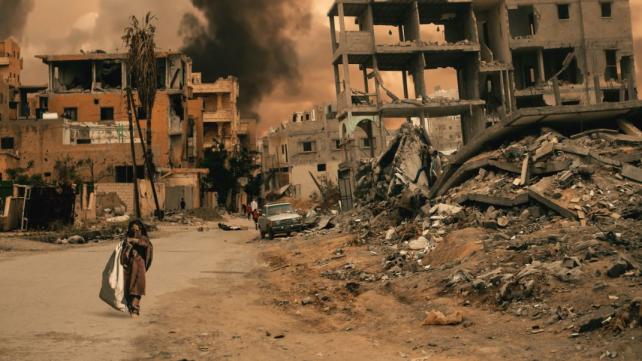
SUMMARY: The people of Gaza, who have endured horrific trials, can draw from the suffering endured by the Prophet Muhammad, may Allah send peace and blessings upon him, and his response.
The humanitarian starvation crisis that has gripped the Palestinians in Gaza is horrific and one of the greatest trials for those enduring it and for those who are both fighting against it and have knowledge of this appalling travesty. When Muslim families in America discuss this emergency, it can be helpful to put things in historical and spiritual perspective. Allah has fashioned the human being to be discerning, reflective and with the capacity to learn from the hardships experienced. During the prophetic age, in the 10th year of revelation received by prophet Muhammad, may Allah send peace and blessings upon him, the community endured what was termed Am al-Huza or the ‘year of sorrow’. We can learn about human resiliency from this history and how to trust in Allah.
The prophet, may Allah send peace and blessings upon him, was spreading the message of Tauheed, Monotheism, to the people. The leaders of the Quraish were very distressed because they felt his message would lead to societal economic and social instability. Economically, the Quraish decided that it was intolerable that this message of the oneness of God was in direct contradiction of their three hundred idols which were a major source of income for those who came there on pilgrimage throughout the Arabian peninsula. In addition, the message put the poor and the enslaved on equal footing as free men which was greatly disliked by the tribal leaders who depended upon the discrimination and stratification in the society giving them power and authority.
So, they preyed upon those in the developing ummah who were considered more vulnerable – the poor, those not part of a large tribe and the enslaved. For example, Bilal ibn Rabah, who would become the first muezzin, was tortured and persecuted for embracing Islam while still enslaved, until Abu Bakr bought his freedom. Summayyah bint Khayat, a freed Abyssinian slave, was tortured to death and became the first martyr in Islam. They were not alone, in fact many Muslims who did not have strong tribal or clan affiliations to protect them asked to leave the area. Thus, we have the first migration to Christian Abyssinia, which included the prominent companion Uthman ibn Affan and his wife Ruqayyah, daughter of the Prophet, may Allah send peace and blessings upon him.
For those Muslims who stayed, the Quraysh started a campaign of collective punishment for the followers, supporters and even sympathizers with the message of Prophet Muhammad, may Allah send peace and blessings upon him. These people endured economic boycott, physical harm and intense hunger. It is reported in seerah that the only thing that saved the people from complete starvation was the help from different clans who helped and were willing to defy the boycott and give the Muslims both food and much needed water.
It was during these intense times of hardship that the Prophet Muhammad, may Allah send peace and blessings upon him, lost his wife Khadijah bint Khuwaylid and uncle Abu Talib ibn Abdul Muttalib. This left him very vulnerable and he was even physically attacked when he reached out to the community in Ta’if as a possible refuge. As the leaders of the community sent children to throw stones and chase him from the city, the prophet, may Allah send peace and blessings upon him, made what is known as the Dua of Taif:
“To You, my Lord, I complain of my weakness, lack of support and the humiliation I am made to receive. Most Compassionate and Merciful! You are the Lord of the weak, and you are my Lord. To whom do You leave me? To a distant person who receives me with hostility? Or to an enemy You have given power over me? As long as you are not displeased with me, I do not care what I face. I would, however, be much happier with Your mercy.”
Discern:
The hadith and stories of seerah are passed down for the past millennium and half for man to understand. The older members of Muslim families can refer to this history to help children understand that the hardships of the early Muslims are a part of the Qadr of Allah and a test of faith. Families recognize that the prophet himself, may Allah send peace and blessings upon him, was tested and called for mercy and the ability to endure. Muslim families in America understand that even physically removed from the atrocities in Gaza, the trial is upon us all and we must call on Allah to strengthen our patience and Iman.
"We will certainly test you with a touch of fear and famine and loss of property, life, and crops. Give good news to those who patiently endure..." (Quran, 2:155)
Reflect
Muslim families in America must weigh in on the significance of the hunger crisis in Gaza. Too often people will feel overwhelmed by the stories of hardship and atrocity. Sometimes, people feel they don’t have the emotional bandwidth to deal with such horror and injustice. There are even some who may feel that their own personal or communal hardships supersede the emergency in Gaza. But we must look to the example of Muhammad, a universal prophet, may Allah send peace and blessings upon him, whose love and concern included those near to him as well as his enemies.
"There certainly has come to you a messenger from among yourselves. He is concerned by your suffering, anxious for your well-being, and gracious and merciful to the believers." (Quran, 9:128)
Learn
When families both understand and reflect upon the hunger crisis in Gaza and relate it back to previous trials faced by the early believers, they can learn about how to respond, courage, patience and tawakkul. Some of the early Muslims migrated away from the boycott, torture and murder just as some Gazans have migrated. Still, many have the courage to remain and fight.
They patiently wait for a resolution to the war as well as aid that is long in coming and often delayed. Many people of Gaza trust and rely on Allah and that He alone will provide the best outcome for them. This test of faith is one that Muslims families can learn from and not give in to despair or doubt.
Author bio: Mahasin D. Shamsid-Deen is the news curator and content manager for Muslim Network TV (MNTV) and contributing writer for Sound Vision. She holds a Master’s degree in English Writing and has worked as both a High School and College ESL Instructor and Writing Instructor for more than a decade. Mahasin has numerous published articles, books, essays and is a published playwright with three award winning stage plays. She is currently writing her dissertation for her doctoral degree.
Related:
Responding to Gaza Genocide with Tawakkul, Sabr and Activism
Turning our Children to Dua when Feeling Helpless about Famine and Genocide in Gaza
Loving how the Prophetic Example informs Response to National Guard Overreach







Add new comment