
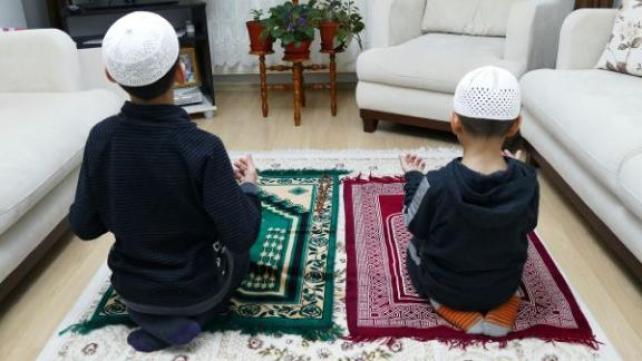
I was brought up in a Catholic household before becoming Muslim, and even then, I was raised with an awareness of God as All-Hearing, All-Seeing, and All-Knowing. From an early age, I was taught that God watched over us all and knew everything we did, good or bad. This awareness naturally deterred bad behavior and sin. When I converted to Islam, that same principle carried over to my new way of life. As Muslims, we strive to achieve ihsan, or excellence in worship, as defined in the Hadith of Jibril – to worship Allah as though we see Him, knowing that even though we cannot see Him, He sees us (Sahih Muslim 8). Islamic spirituality thus encompasses three interconnected levels of faith, namely Islam, iman, and ihsan. Teaching children these three levels from an early age nurtures taqwa, or God-consciousness, and encourages them to strive toward ihsan in their worship.
In my experience with Islamic school curricula, young children are typically taught the five pillars of Islam first. Then they move on to the six pillars of iman, or faith. However, ihsan seems to receive less attention, perhaps because it is considered a more advanced topic. While children may not yet understand all its spiritual depth, they can begin learning what it means to worship Allah with love and sincerity. Simple reminders that Allah sees them, knows their efforts, and sees the good they do even when no one else notices can make this concept more accessible. These early lessons can lay the foundation for a deeper understanding of ihsan as they grow.
The Hadith of Jibril as Storytime
The hadith of Jibril, or Angel Gabriel, is a great starting point for teaching children the basics of their faith. It is not only an authentic prophetic narration but also a storytelling masterpiece in the way it presents the setting, the circumstances, and the dialogue between the Prophet Muhammad, peace and blessings be upon him, and Jibril, peace be upon him, as well as the later conversation with the narrator, Umar ibn al-Khattab. Because of its comprehensiveness, it is frequently used as an introduction to Islamic studies for people of all ages. To teach young children about ihsan, parents and educators can focus on the portion of the hadith that explains Islam, iman, and ihsan, and save the discussion about the Hour for when they are older.
When my eldest children were still toddlers, I decided to turn the hadith of Jibril into a picture book. I retold the story in words little ones could understand and paired it with colorful illustrations showing what the setting may have looked like, without depicting the Prophet Muhammad, peace and blessings be upon him, or the companions, may Allah be pleased with them. I called it The Questioner: The Hadith of Jibril and offered it for some time as a self-published bilingual book. My main reason for creating it was to share the story with my children in Spanish and English, but parents do not need to go to such lengths to teach their children. They can simply share the hadith with them, explain its meaning in age-appropriate language, and discuss what ihsan means and how it applies to our lives.
The following excerpt from the hadith of Jibril, shared by Daily Hadith Online, introduces the three levels of faith:1
Umar ibn al-Khattab reported: We were sitting with the Messenger of Allah, peace and blessings be upon him, one day, when a man appeared wearing very white clothes and having very black hair. There were no signs of travel on him, and we did not recognize him. He sat in front of the Prophet, rested his knees by his knees, and placed his hands on his thighs. The man said, “O Muhammad, tell me about Islam.”
The Prophet said, “Islam is to testify there is no God but Allah and Muhammad is the Messenger of Allah, to establish prayer, to give charity, to fast the month of Ramadan, and to perform pilgrimage to the House if a way is possible.”
The man said, “You have spoken truthfully.” We were surprised that he asked him and said he was truthful. He said, “Tell me about faith.”
The Prophet said, “Faith is to believe in Allah, His angels, His Books, His Messengers, the Last Day, and to believe in providence, its good and its harm.”
The man said, “You have spoken truthfully. Tell me about excellence.”
The Prophet said, “Excellence is to worship Allah as if you see Him, for if you do not see Him, He surely sees you…”
… Then, the man returned, and I (Umar ibn Al-Khattab) remained. The Prophet said to me, “O Umar, do you know who he was?” I said, “Allah and His Messenger know best.” The Prophet said, “Verily, he was Gabriel who came to teach you your religion.” (Sahih Muslim 8)
The hadith of Jibril effectively illustrates that knowledge in Islam is multidimensional. We learn that faith and understanding deepen over time. This can encourage children by showing them that striving for excellence requires patience, practice, and persistence. Learning involves not only the intellect but also the heart and spirit, helping us develop our awareness of Allah and our relationship with Him. Encouraging children to reflect on themselves and notice the beauty and signs of Allah’s creation can cultivate that awareness, so they connect what they learn with what they experience every day.
How to Reach the Level of Ihsan
There are many ways parents and educators can help children understand ihsan and begin striving toward it in their daily lives. Gentle reminders work best. It can be as easy as telling them that Allah is our protector and is always aware of everything that happens to us, or explaining that He sees us when we pray and do good deeds. Weave these reminders into everyday conversations so that remembering Allah becomes natural for them.
Also use questions to guide children to think about how to be more aware of Allah in their daily lives. For example, ask, “Would you take something from a store without paying?” When you ask why not, they may mention cameras or people watching. This can open a conversation about doing what is right even when no one else is around, because Allah is always aware of what we do. Although we cannot see Him, He sees us. Keeping this principle in mind encourages us to be more thoughtful about our choices and mindful in our worship.
Ihsan is about excellence, and we strive for it through practice. We can nurture ihsan through acts of worship such as dua, dhikr, reading the Quran, and praying with care and sincerity. Encourage children to set aside distractions as much as possible so they can focus on their worship. Making dhikr a regular part of their day can also help them remember Allah and become more aware of Him in everyday moments. Because Islam, iman, and ihsan describe levels of faith, encourage your children to see growth in their faith as working toward a goal, like earning a badge. Introduce the words “Muslim,” one who practices Islam; “Mu’min,” a believer; and “Muhsin,” one who strives for excellence in worship. The greatest prize is achieving ihsan. Get them excited about working toward that “Muhsin badge,” while reminding them that growing closer to Allah is a lifelong journey.


Add new comment