
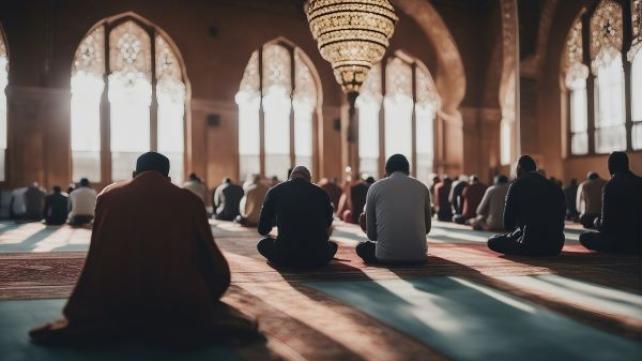
SUMMARY: The leadership of Warith Deen Mohammed prompted a historical mass conversion of African Americans to Islam, in an ongoing journey of guidance, self-discovery, and community assertiveness.
A Conversion Heard Across a “Party Line”
In an era before livestreams, before social media, before even conference calls as we know them today, one of the largest religious transformations in American history happened through a telephone.
They called it a party line.
It was a shared landline system where hundreds, even thousands, could listen in simultaneously. Families gathered around receivers. Former Nation of Islam Mosques amplified the sound through speakers. Entire communities leaned in.
And through that crackling line, many publicly embraced and articulated their shahada.
When Elijah passed on February 25, 1975, leadership of the Nation of Islam shifted to his son, Warith Deen Mohammed.
What followed wasn’t just a change in leadership, but a mass declaration of faith.
The Words That Reshaped a Community
Across cities like Chicago, Detroit, Philadelphia, and beyond, thousands repeated the same words:
Ashhadu an la ilaha illa Allah, wa ashhadu anna Muhammadur rasul Allah.
Historians and community estimates often point to a figure approaching 200,000 individuals who transitioned into orthodox Sunni Islam during this phone transmission.
Unlike individual conversions, this was something rare:
A collective shahada.
Mosques didn’t empty. They transformed.
Communities didn’t scatter. They realigned.
From Doctrine to Revelation
Under Warith Deen Mohammed, long-held teachings of the Nation of Islam began to shift toward mainstream Islamic belief.
Among the most significant changes:
- * The rejection of divinity attributed to Wallace Fard: instead divinity was only attributed to Allah
- * Affirming Prophet Muhammad as the final messenger
- * Establishing the Qur’an and authentic Sunnah as the foundation
- * Implementing daily prayer, fasting the month of Ramadan , and paying zakat
- * Encouraging unity with the global Muslim ummah
For many, this meant relearning Islam from the ground up.
Arabic phrases replaced old terminology. Prayer rows were reformed. A global identity replaced a localized one.
A Necessary Reality Check
But telling this story responsibly requires more than numbers and milestones.
There’s a principle that must remain clear:
We do not know what was in the hearts of those individuals on that day.
While many saw this transition as movement toward a more correct aqeedah, intention is not something history can measure.
That belongs to Allah alone.
What we can say is that for many, this moment was part of a longer process of tarbiyyah: development, growth, and refinement.
Like any Muslim journey, it involved:
- * Learning and unlearning
- * Sincerity and struggle
- * Seeking Haqq step by step
It wasn’t a finish line.
It was a beginning.
Not Everyone Took the Turn
The transition was significant, but not universal.
Louis Farrakhan would later reestablish the original Nation of Islam framework, creating a separate path that continues to this day.
The Next Phase: Maturation and Methodology
The years that followed were just as important as the initial shift.
As communities stabilized, a deeper pursuit of knowledge began to take root.
Many individuals and communities became connected with circles like the Quran and Sunnah Society of the 1980s, where emphasis was placed on:
- * Authentic sources of Islam
- * Structured learning
- * Returning to early Islamic understanding
Over time, this maturation process led many toward adopting the methodology of the righteous predecessors, the salaf, in both belief and practice.
A community that had just transitioned was now refining how it understood and lived Islam.
From America to the Ummah
One of the most visible outcomes of this transformation was global connection.
African American Muslims, many with no immigrant background, began:
- Traveling for Hajj in increasing numbers
- Studying with scholars from across the Muslim world
- Building institutions grounded in orthodox practice
What had once been an isolated movement became part of something much larger: The global ummah.
Why This Moment Still Matters
Today, the effects of that transition are everywhere: in Masjids across America, in families that trace their roots back to that moment., in communities that balance identity, history, and orthodoxy.
It also reframes a deeper narrative: Many African Americans, descendants of enslaved people, some of whom were Muslim, did not encounter Islam as something foreign, but something recognizable.
Something that resonated with their Fitrah.
A Quiet Revolution
History often remembers loud events: marches, speeches, conflicts.
But in 1975 and the years that followed, something quieter, and in many ways more lasting, took place: through telephones lines, mosques and living rooms, sincerity and search.
Hundreds of thousands stood, repeated a testimony, and began a journey.
Final Reflection
We can document the numbers.
We can trace the leadership.
We can map the outcomes.
But the most important part of that day cannot be recorded:
The intentions.
The sincerity.
The private turning of hearts.
That remains with Allah.
What remains with us is the legacy…
A community that moved, learned, and continues to grow.
And a moment in American history when faith didn’t just spread…
It shifted, together.
May Allah Guide all who are lost back to His Obedience and rectify the affairs of the Muslims. Ameen.
Author bio: Abu Hudhayfah Edwards is an author of Islamic children’s books dedicated to amplifying the voices and experiences of young Muslims living in the USA and Canada. As the founder of WKTL Radio, also known as IslamLife Radio, and Medina Educational Institute (MEI), he channels his passion for education and community into engaging stories that reflect the cultural styles and realities of Muslim youth. Once featured in Style Weekly in the article “After These Messages,” where he was described as “stoic and deep thinking,” Abu Hudhayfah Edwards continues to write with purpose and vision, committed to ensuring that Muslim children see themselves represented in the books they read.
Related:
Islam and the African American Ethos




Add new comment