
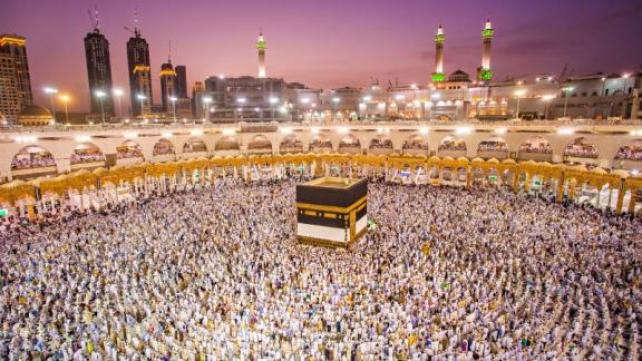
SUMMARY: As Muslims make the Hajj pilgrimage and commemorate these blessed days, let us celebrate the opportunity to visit Allah's House with sensitivity and compassion toward those who have not yet had the opportunity.
For Muslims around the world, the arrival of the Hajj season brings excitement, anticipation, and heartfelt prayers. On social media, timelines fill with messages asking for forgiveness, images of pilgrims dressed in white garments preparing to stand before the Kaaba, and words of supplication as families see their loved ones embark on the journey of a lifetime. Millions of believers will stand in the very places where Prophet Muhammad once walked and prayed, and pay homage to the family of Ibrahim, may Allah send peace and blessings upon them. Communities gather to prepare and celebrate those who are leaving and to pray for the return of those transformed by the experience.
For others, however, Hajj season evokes a different emotion: a sense of longing that cannot be quelled until they, too, are blessed with the opportunity to go on the religious pilgrimage. The Hajj is the fifth pillar of Islam and a goal that most Muslims aspire to, but it may not be feasible for all.
Love, Longing, and the Journey of a Lifetime
I want to speak honestly about something I have wrestled with for many years, not as a criticism of those who have been blessed to perform Hajj or Umrah, but as a reflection that I hope encourages greater compassion and interpersonal sensitivity within our communities. As Muslims, we often speak about emotional intelligence, empathy, and the Prophetic teaching of loving for others what we love for ourselves. Our beloved Prophet Muhammad, peace and blessings be upon him, embodied these qualities more perfectly than anyone. He spoke to people with wisdom, gentleness, and sensitivity in ways that drew hearts toward him. His example teaches us not only what to say and how to say it with mercy and compassion, but also when it may be wiser to remain silent.
As a Muslim convert of over twenty-five years, I have spent many years listening to friends and community members share beautiful stories of Hajj and Umrah while wondering whether I will ever have the opportunity myself. When I see photographs of pilgrims smiling in front of the Kaaba, hear stories about the beauty of Madinah, or scroll past social media posts inviting people to submit duas for someone else to say on their behalf, I feel an overwhelming sense of sorrow because I have not been able to go there in person. I know these gestures are usually well-intentioned. Yet for Muslims who have waited years, or even decades, for the opportunity to visit Allah’s House, those trends can be emotionally distancing rather than comforting. When people’s multiple Hajj or Umrah stories started to sting, I questioned whether the sadness I felt stemmed from resentment or even jealousy. It was not until I revisited a relevant hadith that I realized these emotions were neither blameworthy nor unusual. The Prophet Muhammad, peace and blessings be upon him, once said:
“There is no envy but in two cases: a man whom Allah has given wealth, and he spends it rightly, and a man whom Allah has given wisdom, and he judges and teaches with it.” (Sahih Bukhari 73, Sahih Muslim 816)
The scholars explain that this type of “envy” is not the destructive kind rooted in bitterness or wishing blessings to be taken away from others. Rather, it is a sincere hope that Allah may grant a person similar opportunities for goodness, worship, and reward. In the case of Hajj and Umrah, what believer would not yearn to stand before the Kaaba, pray in Madinah, and fulfill one of the greatest acts of worship in Islam? Praying for such an opportunity is both natural and spiritually commendable because it reflects a believer’s sincere desire to come closer to Allah.
Waiting for an “Invitation”
Although many people encourage others to simply pray that Allah makes a way for them to go to Hajj or Umrah, the reality is often far more complicated. Allah is certainly capable of opening doors in unimaginable ways, but we still have to do the work of “tying the camel.” Many Muslims face real financial, physical, emotional, and logistical obstacles that cannot be ignored. Hajj and Umrah are expensive, and, for the most part, only those who have been given wealth or have saved enough over the years can afford these trips. With nearly two billion Muslims in the world today, only a small percentage will perform Hajj or Umrah. Saudi Arabia reported welcoming approximately 18.5 million pilgrims in 2024-2025, including about 1.61 million for Hajj and 16.9 million Umrah visitors.1 Even though these numbers are remarkable, they still represent less than one percent of the global Muslim population – a reminder that the overwhelming majority of Muslims around the world stay behind, mourning a journey they may never be able to make.
In recent years, it has become common for pilgrims to describe themselves as having been “invited” by Allah to His House. I understand the sentiment behind those words. People are expressing gratitude and awe after experiencing something sacred. But for those who have spent decades longing for Hajj while lacking the means or physical ability to go, hearing this language repeatedly can wound the heart. It can unintentionally create the impression that those who made the journey were specially chosen, while others were somehow left outside the invitation.
For many convert families, especially, the path to Hajj or even Umrah is not so easy. Behind the hopeful statements of “in sha Allah” and “Aameen” to the duas of their co-religionists lie realities that are invisible to others, such as financial hardship, large families, caregiving responsibilities, chronic illness, immigration concerns, unstable work situations, or the absence of family support systems that many born Muslims may take for granted. Some converts spend years fixing broken relationships with relatives, paying off debt, raising children on a single income, or simply trying to survive rising living costs. Others are navigating the emotional isolation of learning and practicing Islam on their own.
The hidden struggles many Muslims experience are why certain phrases, even when spoken with good intentions, can sometimes hurt more than people realize. The truth is that Allah’s invitation is open to all believers. The doors of His mercy are not reserved for the wealthy, the healthy, or the socially connected. Hajj is an obligation only upon those who are truly able, and Allah knows every longing heart, every private dua, and every tear shed by someone who dreams of seeing the Kaaba one day. Their efforts are never overlooked, and even if they are unable to go in person, they will be rewarded for their intention to fulfill this pillar of faith.
The Hurdles to Hajj
While every family’s circumstances are different, many Muslim converts juggle responsibilities that remain largely unseen within the community. These realities do not diminish their love for Islam or their desire to fulfill Hajj. In many cases, they increase their determination because converts are seeking closeness to Allah and a redirection for their life. For many new Muslims, embracing Islam meant starting life anew in more ways than one. Some entered the faith with debt from difficult chapters of their past. Others lost financial support from relatives after becoming Muslim or found themselves navigating life without the safety nets that extended Muslim families often provide. While some Muslim families across generations can save collectively for Hajj, many converts are simply trying to keep up with the daily costs of survival. For larger families in particular, the cost of Hajj can feel less like a distant goal and more like an impossibility.
Beyond the financial strain lies the immense isolation that can come with religious conversion. Some new Muslims practice Islam almost entirely alone. There are no Muslim parents helping them prepare spiritually for Hajj, no relatives offering to watch the children, no grandparents contributing toward travel expenses, and no lifelong family tradition connected to the pilgrimage itself. Even conversations about Hajj can sometimes feel lonely when one carries a deep longing that no one around them fully understands. For me personally, I cannot even bring up the topic with my non-Muslim family without it stirring up a debate about travel safety, politics, and religion.
When it comes to parents and caregivers, especially mothers, the situation becomes even more complex. Many place their own spiritual aspirations on hold while caring for young children, elderly parents, disabled loved ones, or family members struggling with illness. Years pass quickly in service to others. A mother may spend decades tending to everyone else’s needs before ever considering whether a journey like Hajj is physically, emotionally, or financially possible for herself. There are also Muslims whose health conditions make the pilgrimage extraordinarily difficult. Chronic illness, disability, aging, pregnancy, mental health struggles, or physical limitations can complicate what others may casually describe as an easy trip.
Celebrating with Compassion
Recognizing these hard truths should not diminish our happiness for those who complete Hajj or Umrah. On the contrary, we should celebrate them sincerely and ask Allah to accept their pilgrimage. But perhaps it should also increase our humility, gratitude, and compassion in the way we speak about these journeys. Not everyone who wants to go for Hajj is able to “just save up.” Not everyone who remains behind lacks effort, planning, or sincerity. Sometimes people are dealing with problems that others cannot see, despite their consistent duas.
People’s struggles are invisible in the likes, polished images, and celebratory posts that flood social media, and that is why emotional sensitivity matters in our communities. There is nothing wrong with sharing the joy of Hajj or Umrah or expressing gratitude for the blessing of reaching the House of Allah. However, we should speak about it with humility and awareness, recognizing that many sincere Muslims remain unable to go due to circumstances beyond their control. It is important to be mindful of language that suggests that some people were specially “chosen” or “invited” while others were passed over. Rather than allowing Hajj and Umrah to become markers of status or spiritual distinction, our communities should use these moments to increase compassion, generosity, and collective care. Islamic centers and organizations can assist struggling families, provide childcare for traveling parents, or contribute toward someone’s dream of going for Hajj or Umrah. Most importantly, we can make dua not only for those embarking on the journey, but also for those who are still waiting and wondering if their turn will come.






Add new comment