
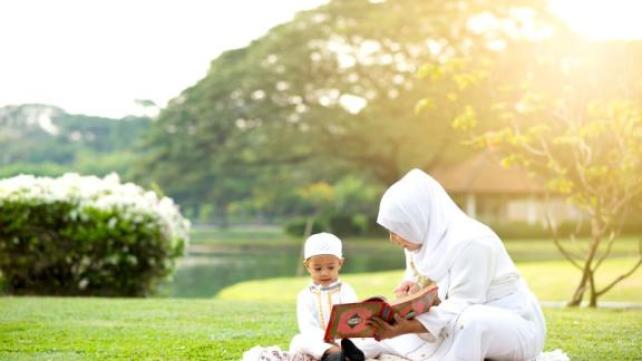
SUMMARY: Motherhood in the Islamic tradition is honored both for those who provide biological maternal nurturing and spiritual care.
May is the month of motherhood in the United States for several reasons, including the celebration of Mother’s Day on the second Sunday of the month. It also falls in the spring, a season that symbolizes rebirth, fertility, and abundance. What many Muslims may not realize is that May is also dedicated to the Virgin Mary in the Catholic tradition. Throughout the month, there are numerous observances that honor Maryam not only as the mother of Jesus, peace be upon him, but also as a spiritual mother to Christians. This understanding of spiritual motherhood is similar to the title given to the wives of the Prophet Muhammad, may Allah send peace and blessings upon him, who are known as the “Mothers of the Believers,” even though most of them did not have biological children.
Allah says in the Quran:
“The Prophet has a stronger affinity to the believers than they do themselves. And his wives are their mothers…” (33:6)
Through this verse, Allah establishes that the wives of the Prophet Muhammad, peace and blessings be upon him, are unlawful in marriage to anyone after his death. At the same time, it elevates these women to the status of symbolic “mothers” to the entire body of believers, from that time until the Last Day. This is the origin of the title Ummahat al-Muminin, or “Mothers of the Believers.”
Out of all the Mothers of the Believers, only Khadijah bint Khuwaylid bore the Prophet’s children, peace and blessings be upon him. Others, such as Sawdah bint Zamaah, Umm Habiba (Ramlah bint Abi Sufyan), and Zaynab bint Khuzayma, had children from previous marriages. The rest, which include Aisha bint Abu Bakr, Hafsa bint Umar, Zaynab bint Jahsh, Juwayriyah bint al-Harith, Safiyya bint Huyayy, and Maymunah bint al-Harith, did not have children at all. Nevertheless, all of these women, may Allah be pleased with them, embodied strength, dignity, and true femininity in Islam. Their lives remind us that our spiritual “mothers” were not defined by childbirth alone. When we honor mothers, we can also recognize and celebrate the fullness of femininity in Islam, making space to value all women for the roles they play in nurturing, guiding, and strengthening the community.
Powerful women have been part of our faith tradition since the dawn of humanity, but it was not childbearing that set them apart. Hawwa (Eve) was created from the rib of Adam, peace be upon him, but she was no less human than he. Both were given knowledge, responsibility, and the ability to discern right from wrong, and when they sinned, neither was deemed more blameworthy than the other. Before becoming a biological mother, Hawwa was already a foundational figure in the story of humanity.
Likewise, before the annunciation of the birth of Isa, peace be upon him, Maryam was already known as an exceptional woman of worship. She was modest, truthful, and sincerely devoted to Allah alone. Asiyah, the wife of Pharaoh, was not defined by motherhood, yet her faith elevated her to the ranks of the greatest women. She took the infant Musa, peace be upon him, into her care and raised him with compassion and courage. When he was later commissioned as a prophet, she was among the first to believe, ultimately giving her life in steadfast devotion to the truth.
The Prophet Muhammad, may Allah send peace and blessings upon him, once said:
“There were many men who achieved perfection, but none were perfect among women except Asiyah, the wife of Pharaoh, and Mary, the daughter of Imran. Verily, the virtue of Aisha over other women is like the virtue of a fine stew over all other foods” (Sahih al-Bukhari 3411, Sahih Muslim 2431).
What is especially striking about this hadith is that after mentioning two of the most exemplary women of all time, the Prophet, may Allah send peace and blessings upon him, draws attention to his wife, Aisha, and what distinguished her among the women of her time. He compares her to a dish known as tharid, a hearty meal of bread, broth, and meat that was considered one of the finest foods in Arabia, often reserved for special occasions. Just as this dish was favored above others, Aisha stood out for her exceptional virtues. Her status was not defined by biological motherhood, but by her faith, intellect, and lasting contributions to the Muslim community.
Unlike Maryam, who was a mother to Isa, peace be upon him, and Asiyah, who cared for Musa, peace be upon him, as a foster mother, Aisha did not become the mother of a prophet. Rather, she was the wife of a prophet and, after his passing, a spiritual mother to an entire community. She was a teacher, a scholar, and one of the greatest narrators of hadith. After the death of the Prophet Muhammad, may Allah send peace and blessings upon him, she became a trusted guide, offering knowledge, insight, and counsel to his companions.
One of the companions, Abu Musa, may Allah be pleased with him, said about Aisha:
“We never had a problem occur to us, the companions of the Messenger of Allah, peace and blessings be upon him, but that we would ask Aisha and find that she knew something about it” (Sunan al-Tirmidhi 3883).
Because of her close relationship with the Prophet, may Allah send peace and blessings be upon him, Aisha gained deep insight into the religion and the character expected of a believer. The companions relied on her narrations and sought her guidance on religious matters due to her exceptional memory and scholarship. Her role as a spiritual mother extended beyond her own lifetime, nurturing and guiding even later generations of Muslims. Masruq ibn al-Ajda, a prominent Tabii from the generation after the companions, said:
“By the one in whose hand is my soul, I saw the learned elders among the companions of Muhammad, may Allah send peace and blessings upon him, ask her about the (spiritual) obligations” (Musannaf Ibn Abi Shaybah 30387).
Even to this day, we rely on the wisdom left by our mother Aisha, preserved in the major hadith collections, drawing from her knowledge and her detailed descriptions of the life of the Prophet Muhammad, may Allah send peace and blessings upon him. Her legacy reminds us that nurturing a community is not limited to raising children, but also includes preserving knowledge, shaping character, and guiding others toward what is right. The lives of Aisha and the other Mothers of the Believers show that femininity is not confined to biological roles but is expressed through faith, service, and contribution to the well-being of the community. In celebrating motherhood this month and beyond, we can expand our understanding to include all women, both those who give life and those who give strength.
Related:
(1) Being a Servant Leader: Mothers as Shepherd
(2) Emotional Strength and Support Systems: Lessons from Khadijah






Add new comment