
Hamza decided, at exactly 9:17 p.m., that he was done being the oldest.
He sat on the edge of his bed with one sock in his hand and one sock missing, staring at the floor like the floor had personally offended him. Somewhere down the hall, a child screamed in pure joy or pure rage. With seven children in the house, it was often hard to tell the difference.
“Hamza!” his mother called. “Laundry room. Now, please.”
He exhaled the kind of sigh that made him sound forty-five, then stood up and walked out into the storm.
The night before Eid al-Fitr always felt like someone had taken normal life, poured in excitement, added sugar, then shook the whole house until every lid popped off.
In the living room, Ameenah, eleven and confident, was holding up a dress to her chest like she was presenting it to a panel of judges.
“This one,” she declared.
Hameed, thirteen and dramatic, leaned over the couch. “That’s not Eid. That’s… a you going to a cookout abaya.”
Ameenah’s eyes narrowed. “It’s Eid enough.”
Hamza didn’t stop. He headed for the laundry room, where the real war was already underway.
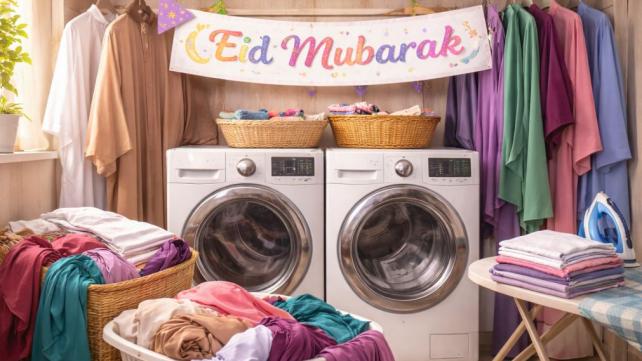
A laundry basket sat in the doorway like a warning sign. Shirts, pants, hijabs, and socks overflowed as if the basket had given up on boundaries. Their mother stood with her sleeves rolled up, holding a white thobe in one hand and a stain remover in the other. Her expression was calm, but Hamza could tell it was the calm of someone who had accepted that chaos was part of worship tonight.
“Tell me,” she said, “why this thobe has a mystery mark on the sleeve.”
Hamza glanced at it, “Maybe it’s… barakah”, he said with a mouthful of sarcasm.
His mother gave him a look.
Hamza corrected himself immediately. “It’s from Hasan. He hugged me after he ate chocolates with sticky hands.”
From the hallway, Hasan’s small voice shouted proudly, “I hugged everybody!”
Hamza’s mother turned toward the sound. “Hasan, sweetheart, no more hugs until after showers.”
Hasan responded with the only argument a five-year-old needed. “But it’s Eid soon!”
“It’s Eid soon,” Hamza muttered, like that explained everything wrong with the world.
Hud, nine and sneaky, slid into the laundry room like a cat. He held up a wrinkled shirt with a grin. “Do I have to iron this?”
Hamza’s mother didn’t look away from the thobe. “If you want to wear it.”
Hud’s grin faltered. “What if I don’t want to wear it?”
“Then you’ll wear something else,” she said, still calm.
Hud brightened. “Like Hamza’s hoodie.”
Hamza’s head snapped around. “Absolutely not.”
“It’s soft,” Hud argued.
“It’s mine,” Hamza replied.
“It’s Eid,” Hud insisted, as if Eid had the power to transfer ownership.
Hamza pointed at him. “Eid doesn’t make you king.”
Hud shrugged. “It kinda does.”
From the kitchen, a new problem emerged.
Asiyah, seven and sharp, came running with the urgency of a messenger.
“Ummi!” she announced. “Ameenah is trying to eat the Eid treats.”
Ameenah’s voice followed from behind her. “I am not. I was just… checking them.”
Hameed strolled in after them, hands in his pockets. “She was checking them with her mouth.”
Ameenah gasped. “Hameed!”
Their mother finally put the thobe down and turned. “No one eats the Eid snacks tonight.”
Ameenah crossed her arms. “But we fasted the whole month.”
“And we broke the fast every night,” their mother replied gently. “Tonight is for preparing.”
Asiyah’s eyes went wide. “What if… the snacks go bad?”
Hamza stared at her. “It’s cookies.”
Asiyah whispered, “Cookies can get sad.”
Before anyone could answer that, Aliyah, three years old, small and unstoppable, appeared in the doorway wearing a scarf wrapped around her head like a crown. It wasn’t a hijab, exactly. It was a towel.
“I’m ready,” Aliyah announced.
Ready for what, no one knew.
Hasan clapped. “Aliyah is a princess!”
Aliyah lifted her chin. “Eid princess.”
Hamza couldn’t help laughing. The laugh surprised him, as it came from a place that had been tired all day but still had love stored up.
Then the bathroom door slammed.
Hameed’s voice echoed down the hall. “WHO USED ALL THE TOOTHPASTE?!”
Hamza’s mother closed her eyes briefly. “Everyone. Everyone used the toothpaste.”
“That’s not possible!” Hameed protested.
“Everything is possible,” Hamza murmured, “especially in this house.”
Their father’s voice rose from the living room, calm and steady like a lighthouse. “Toothpaste is in the cabinet. New one. Bismillaah.”
The words “Bismillah” had an effect in the house like a soft hand on the shoulder. Not magic, exactly. Just a reminder that the point of all this was worship, gratitude, and joy.
Still, the chaos didn’t stop.
Hamza went back to his room to find his missing sock. He found it under Hasan’s stuffed bear. He didn’t ask why.
He also found his “Eid outfit” folded neatly on his chair, dark pants, a crisp shirt, and then noticed the shirt had a wrinkle down the middle like a road.
He stared at it. “Iron,” he whispered, as if saying it quietly would make it go away.
In the hallway, Ameenah was already arguing with Hūd about shower turns.
“I was here first,” Hud said.
“No, you weren’t,” Ameenah replied. “I literally saw you run away.”
“I ran to get my towel,” Hud countered.
“You ran to hide,” Ameenah said.
Hud’s eyes widened. “That’s not hiding. That’s… strategic waiting.”
Hamza stepped between them. “Okay, listen. You’re both going to shower. Nobody is skipping.”
Hud scowled. “I showered yesterday.”
Hamza raised an eyebrow. “So did the trash can, and we still take it out today.”
Ameenah laughed. Hud looked offended but didn’t have a comeback.
Then Asiyah popped up, holding a tiny toothbrush like it was a microphone. “Do we have to brush our teeth before we sleep?”
Hamza turned slowly. “Yes.”
Asiyah frowned. “But I brushed already.”
Hamza shrugged. “Brush again, you have Pre-Eid breath.”
Asiyah nodded seriously, as if Eid breath was an achievable documented phenomenon.
The washing machine beeped. Their mother pulled out damp clothes with the focus of someone performing surgery. She hung some on hangers. She tossed others into the dryer. She glanced at a small pile and sighed.
“These need ironing,” she said, more to herself than anyone else.
Hamza wanted to pretend he didn’t hear it. He really did.
But then he saw his mother’s hands, tired, moving anyway. He saw how she kept everything running like the heart of the house. And something inside him softened.
“I’ll iron,” Hamza said before he could change his mind.
His mother looked up. Her face brightened in a way that made Hamza feel both proud and slightly embarrassed. “Jazak’Allah khayr!”
Hamza shrugged like it was no big deal. “Wa iyyak.”
He carried the clothes to the ironing board. The iron hissed like it had opinions. Hamza began with Hameed’s shirt and immediately learned that ironing was not simply “pressing.” It was a full-body experience in humility.
Hameed walked in, hair wet, smelling like soap, and pointed. “That’s my shirt. Be careful.”
Hamza didn’t look up. “I know.”
Hameed leaned closer. “You’re doing it wrong.”
Hamza paused. “Do you want to iron it yourself?”
Hameed stepped back. “No. Continue.”
Hamza smirked. “That’s what I thought.”
In the kitchen, their father was arranging small gift bags on the counter. Not huge gifts, but thoughtful ones, little books, candies, a small toy for Hasan, hair clips for Asiyah, a bracelet for Ameenah. Hamza pretended not to notice, because older brothers weren’t supposed to care, but he did.
Hud crept toward the counter. “What’s in the bags?”
Their father smiled. “Eid surprises.”
Hud squinted. “For who?”
Their father’s smile widened. “For good kids.”
Hud straightened immediately. “I am the best kid.”
From the living room, Asiyah called, “No, Hasan is.”
Hasan shouted back, “I’m good!”
Aliyah bounced in place. “I’m good too!”
Hameed walked past, pretending he didn’t care. “I don’t even want a gift.”
Hamza raised an eyebrow. “Sure.”
Hameed held his chin up. “I only want money.”
Everyone laughed, even their father.
Later, when the last shower had been negotiated, when the last toothbrush had been used, when the last argument had burned out like a firework, the house finally began to slow.
The slow bustling of family cohesion stretched across the house like a quilt, each piece different, all of them stitched together by love, faith, and shared exhaustion.
Their mother laid out outfits on the couch like a fashion show no one asked for. Their father checked the prayer times for Eid morning and reminded them gently.
“Tomorrow,” he said, “we wake early. We pray. We thank Allah. We visit family. We have fun. But we begin with worship.”
Hamza sat on the floor with Hasan leaning against him, already half asleep.
Ameenah sat beside Asiyah, braiding her hair slowly. Hūd tried to peek at the gift bags again but got caught and sent away with a look. Hameed sprawled on the couch, acting too cool for everything while secretly smiling.
Aliyah sat in the middle of the room, still wearing the towel on her head, whispering to herself, “Eid princess… Eid princess…”
Hamza looked around and felt something he didn’t have words for.
Ramadan had been long. Beautiful. Hard. And now it was ending, not with sadness, but with this strange, shining noise called family.
Their mother turned off the lights one by one.
“Everyone,” she said, voice softer now, “make du‘ā’ before you sleep.”
Hamza closed his eyes. He whispered thanks for a month that had changed them, even if just a little. He whispered thanks for a house that was loud but safe. He whispered thanks for siblings who annoyed him and also made his life full.
And as he drifted toward sleep, he realized something.
The night before Eid wasn’t just preparation for a day of fun.
It was the proof of what they had survived together.
The beauty and chaos of a large Muslim family, pressing wrinkles out of fabric, pressing forgiveness into hearts, and pressing their lives, again and again, toward Allah.
…………………….
Author bio: Abu Hudhayfah Edwards is an author of Islamic children’s books dedicated to amplifying the voices and experiences of young Muslims living in the USA and Canada. As the creator of WKTL Radio, also known as IslamLife Radio, and Medina Educational Institute (MEI), he channels his passion for education and community into engaging stories that reflect the cultural styles and realities of Muslim youth. Once featured in Style Weekly in the article “After These Messages,” where he was described as “stoic and deep thinking,” Abu Hudhayfah Edwards continues to write with purpose and vision, committed to ensuring that Muslim children see themselves represented in the books they read.




Add new comment