
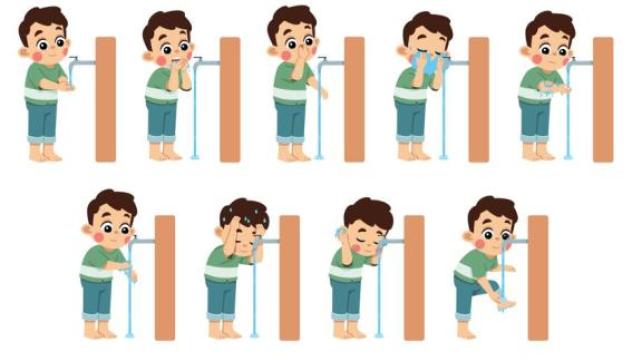
SUMMARY: Steps and tips to teach young children about wudu.
The Islamic tradition emphasizes cleanliness, and one of the ways Muslims stay clean throughout the day is by performing wudu, or ritual washing. Wudu, or ablution, is necessary for Islamic practices like prayer, touching the Quran, and performing tawaf around the Kaaba. It is also recommended before engaging in other acts of worship, such as supplication, and even before sleeping. In fact, it is considered an act of worship in itself. Naturally, wudu is one of the first lessons Muslim parents teach their children to help them prepare for other obligatory actions. While it may seem simple, teaching young children is not always easy, so parents and caregivers need to approach this topic with knowledge and wisdom.
First and foremost, a question we must ask ourselves is how we, as Muslims, know about wudu? Our two main religious sources, the Quran and Sunnah, outline this important ritual. Allah says in the Quran:
“O believers! When you rise up for prayer, wash your faces and your hands up to the elbows, wipe your heads, and wash your feet to the ankles. And if you are in a state of ˹full˺ impurity, then take a full bath. But if you are ill, on a journey, or have relieved yourselves, or have been intimate with your wives and cannot find water, then purify yourselves with clean earth by wiping your faces and hands. It is not Allah’s Will to burden you, but to purify you and complete His favor upon you, so perhaps you will be grateful.” (Quran, 5:6)
For younger children, it is perfectly okay to focus on the first part of the verse that lists the steps for ablution, like washing the hands, head, and feet. Talking about tayammum is also a good idea as a side note, in case they are ever in a situation where water is unavailable. Once children approach adolescence, around ages 9-10, parents are encouraged to consider introducing ghusl, the complete ritual bath. Notice that Allah says that He does not want to burden us, so we must not think of wudu as a chore, but as a way of coming closer to Allah and doing what is most pleasing to Him.
According to prophetic narrations, the places where we washed for wudu will emit light on the Day of Judgment. To get children excited about perfecting their wudu, relate to them the following hadith:
Abu Huraira reported that the Messenger of Allah, our beloved Prophet Muhammad, peace and blessings be upon him, said, “Verily, my nation will be called on the Day of Resurrection as brightly radiant from the traces of ablution. Whoever among you is able to extend his radiance, let him do so.” (Sahih Bukhari 136, Sahih Muslim 246)
With that beautiful reassurance in mind, here are some easy ways to teach your children how to do wudu:
1. Learn the basics, teach the basics
Did you know that only some parts of wudu are required, while others are recommended? Many Muslims are unaware that there is a minimum and an extended version until they take a class on the fiqh of wudu. The essential parts of the ablution are washing the face, washing the arms up to the elbows, wiping the head, and washing the feet up to the ankles, in that order. Anything extra you teach your child is up to you and to the school of thought you follow.
Also, remember that teaching how to make wudu is not the end of the process. This important lesson must also include what invalidates wudu, such as passing wind and using the bathroom. Children must be aware of these, so they know when to renew their wudu. There are also many Sunnah acts that the Prophet Muhammad, peace and blessings be upon him, did as part of his ablution. You can introduce these little by little, depending on your child’s age and learning ability.
2. Show and tell
Kids learn more by observing than they do from long, extended lectures. A huge part of learning wudu will be through watching their parents and other adults around them. Start by taking the children with you into your wudu area, whether it’s the bathroom at home, the wudu station at the masjid, or a sink in another part of the house. Explain to them that you will be performing wudu and that they should watch you carefully. You can even quiz them to see if they were paying attention! Another fun activity is having your child bring in a favorite action figure, doll, or stuffed animal and letting them “show” how they make wudu.
3. Make a song about it
As a teacher, I learned that one of the most reliable ways for children to retain information is through song and repetition. Those movies, shows, and songs that your child has on repeat in their devices are not just there to annoy their parents and other adults. This is the way kids learn. I always remind parents to remember how we learned our ABCs and how we still use them to alphabetize. Even a little silly rhyme like “Right hand one, left hand two, wash your mouth and your nose too!” will yield surprising results.
4. Paste a diagram
If you ever came over to my house and used the restroom, you would see a laminated image of the wudu steps taped right above the sink. No, it is not an eccentric decoration, it is for my kids so they can 1. Remember to make wudu after using the restroom, and 2. Remember every step of the process. Having an illustrated step-by-step guide is as easy as searching for one online or creating one, printing it, laminating or framing it, and placing it in a visible location. Make it a game by taking a copy, cutting all the steps into pieces, and letting your children put them together in order.
5. Observe and correct
When your children first start practicing their wudu, make sure you are standing close by to see if they are doing it properly. If you need to correct them, do so gently. There is a lovely story about how the grandsons of the Prophet Muhammad, peace and blessings be upon him, Hassan and Hussein, taught a man about wudu. One day, when they were still children, they saw an older man performing wudu incorrectly. They wanted to teach him the right way without embarrassing him, so they approached the old man and said:
“My brother and I disagree over who amongst us performs wudu the best. Would you mind watching us make wudu and judging to see which one of us indeed performs wudu more correctly?”
The man cheerfully agreed and watched carefully as one by one the grandsons of the Prophet, peace and blessings be upon him, performed a perfect wudu. In the end, he understood that it was he who had been doing it wrong all along! He said:
“By Allah, I did not know how to perform wudu before this. You have both taught me how to do it correctly.” (Manaqibul Imam Al’Azam, vol. 1, pg. 39)
As Muslims, we are encouraged to do everything with excellence, wudu included. We have a responsibility to instill these lessons in the youth so they can carry the torch for future generations of believers. Remember that for children, learning wudu is the beginning of a lifetime filled with worship and devotion to Allah. In due course, your children will become pros at making wudu, and you will be rewarded for teaching them, insha’Allah.


Add new comment