
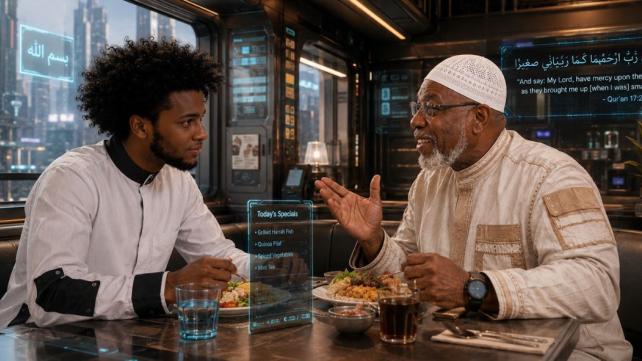
Honoring Our Parents by Remembering the People They Loved
There are some acts of kindness toward our parents that seem obvious.
We call them.
We visit them.
We make sure they have what they need.
And when Allah decrees that they return to Him, we make du’aa for them, give charity on their behalf, and try to continue the good they taught us.
But there is another form of honoring our parents that can easily disappear after their deaths.
Remembering the people they loved.
The Prophet Muhammad (pbuh)specifically taught his Ummah that maintaining relationships with the people our parents loved is an extraordinary form of righteousness.
ʿAbdullāh ibn ʿUmar (ra) reported that the Messenger of Allah (pbuh)said:
“Indeed, the finest act of kindness is for a man to maintain relations with the people his father loved.” Sahih Muslim, 2552
Ibn ʿUmar did not merely narrate this teaching.
He lived it.
While traveling toward Makkah, Ibn ʿUmar encountered a Bedouin whose father had been a friend of his own father, ʿUmar ibn al-Khattāb (ra).
Ibn ʿUmar gave the man the donkey he had been riding and removed his turban and gave that to him as well.
His companions were surprised by his generosity. They essentially reminded him that the man was a Bedouin and would probably have been satisfied with much less.
But Ibn ʿUmar understood something deeper.
This man’s father had loved his father.
And that relationship mattered.
He then reminded his companions of the Prophet’s (pbuh)teaching about maintaining relationships with the people one’s father loved.
The Friendship Does Not Have to End
When our parents die, something often happens quietly.
Their social world begins disappearing with them.
Their phone may stop ringing.
Their friends may attend the janazah, visit the family, share memories, and offer condolences.
Then everyone gradually returns to life.
But perhaps your father had a friend he knew for forty years.
Perhaps your mother had a sister in Islam who sat beside her at the masjid every week.
Maybe there was an “Uncle” who was never actually your uncle but was present at every Eid gathering you can remember.
Or an “Auntie” who knew you before you were old enough to know yourself.
Those relationships were part of your parents’ lives.
Why should they suddenly become strangers to you?
Sometimes honoring our parents means deciding:
My father loved you, so I will not forget you.
My mother cared about you, so you still have family here
Sometimes, Just Call
It does not always require money.
Call them.
Not because something is wrong.
Not because you need information about your parents.
Simply call to chat.
“As-salaamu alaykum, Uncle. I was thinking about you today. How have you been?”
Imagine what that call might mean to an elderly Muslim whose closest friends are slowly passing away.
And listen when they start telling stories.
You may hear the same story about your father for the fifteenth time.
Smile anyway.
One day you may desperately wish there were someone left who could tell it for the sixteenth.
Save Them a Seat at the Table
Invite them to lunch occasionally.
Better yet, invite them to family gatherings.
If your parents always included them at Eid, perhaps there should still be a place for them at Eid.
Bring your children along when you visit.
Introduce them with affection:
“This is Uncle Fulaan. He was your grandfather’s friend.”
“This is Auntie Fulaanah. She and your grandmother were very close.”
Depending upon your family’s culture, perhaps it is Ammu, Amma, Uncle, Auntie, or another respectful title.
Now something beautiful has happened.
A relationship that began with your parents has crossed into another generation.
Your children learn that family is not understood only through surnames and bloodlines. They witness loyalty, gratitude, Islamic brotherhood and sisterhood.
They see you honoring someone because someone you loved once loved them.
Look for What They May Not Ask For
As our parents’ friends become elderly, checking on them can also become practical.
“Do you need anything from the grocery store?”
“I’m heading that way. Would you like me to pick something up?”
And, with their permission, pay attention to their home.
Is the grass becoming difficult for them to maintain?
Is there a railing that has become loose?
A light fixture they cannot safely reach?
A leaking faucet?
A smoke detector chirping somewhere upstairs?
A porch step that needs repairing?
Do not walk into someone’s home and begin treating them as incapable. Preserve their dignity. Ask permission.
“Uncle, would you mind if I took a look at that?”
“Auntie, if you’d like, I can come Saturday and take care of the yard.”
That difference matters.
We are serving elders, not taking authority over them.
Tell Them Why
Perhaps the most beautiful part is occasionally telling them why you keep coming.
“My father loved you.”
“My mother always spoke highly of you.”
“You were important to them, so you are important to us.”
Think about what those words communicate.
Your friendship mattered.
Your years together mattered.
The person you loved has died, but the love they planted did not disappear with them.
There is something profoundly Islamic about that.
We live in a time when relationships can become disposable. People move, numbers change, social circles change, and decades of friendship can slowly become photographs and memories.
Islam teaches something better.
Loyalty can outlive death.
So perhaps there is someone you should call today.
Someone whose number is still saved in your father’s old contacts.
Someone who still remembers your mother as the young woman she once was.
Someone who held you as a baby, attended your wedding, watched your family grow, and stood beside you at your parent’s janazah.
Call them.
Take them to lunch.
Bring the grandchildren.
Ask whether they need anything.
Listen to another old story.
Because sometimes honoring the people our parents loved is another beautiful way of saying:
I still remember you, Mom.
I still remember you, Dad.
And I have not forgotten the people you loved.
Author bio: Abu Hudhayfah Edwards is an author of Islamic children’s books dedicated to amplifying the voices and experiences of young Muslims living in the USA and Canada. As the creator of WKTL Radio, also known as IslamLife Radio, and Medina Educational Institute (MEI), he channels his passion for education and community into engaging stories that reflect the cultural styles and realities of Muslim youth. Once featured in Style Weekly in the article “After These Messages,” where he was described as “stoic and deep thinking,” Abu Hudhayfah Edwards continues to write with purpose and vision, committed to ensuring that Muslim children see themselves represented in the books they read.






Add new comment