
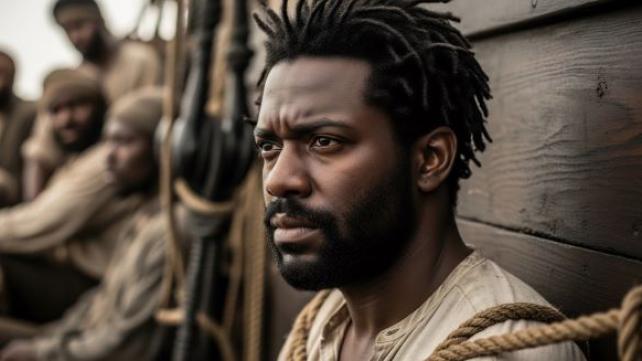
SUMMARY: The career of an enslaved black Moroccan who carved a name for himself in the early Spanish incursions into the Americas challenges popular conceptions of early contact between the Americas, Europe, and Africa.
By the time most Americans learn about the “exploration” of North America, the story usually sounds familiar.
European ships. Spanish armor. Christian missionaries. Conquistadors planting flags into unknown soil.
But hidden inside one of the earliest recorded survival stories in American history is a nearly forgotten figure whose life complicates that entire narrative.
He was Black. He was Moroccan. He likely spoke Arabic. And, according to many historians, he may have been among the earliest Muslims ever documented traveling across what would become the United States.
His name was Mustafa Azemmouri, though history remembers him more commonly as Estevanico.
And nearly 500 years ago, he walked across North America long before the Pilgrims ever landed at Plymouth Rock.
From Morocco to the New World
Estevanico was born around 1500 in the Moroccan port city of Azemmour, then part of the Muslim world of North Africa. Historians believe he was likely raised as a Muslim before eventually being enslaved amid Portuguese expansion along the Atlantic coast.
According to historians and Spanish colonial records, he was sold into slavery and eventually brought into the service of Spanish nobleman Andrés Dorantes de Carranza.
Then came the disastrous Narváez expedition.
In 1527, Spanish explorer Pánfilo de Narváez launched a massive expedition intended to claim and colonize lands in Florida and the Gulf Coast region for Spain. The mission quickly descended into catastrophe.
Storms wrecked ships. Disease spread. Supplies disappeared. Men starved, and many drowned. By 1528, the expedition had collapsed almost entirely along the Gulf Coast near present-day Texas.
Only four people survived. One of them was Mustafa Estevanico.
According to Álvar Núñez Cabeza de Vaca’s famous chronicle La Relación, the survivors spent years traveling across enormous stretches of North America while attempting to reach Spanish territory in Mexico.
Those journeys likely carried them through parts of present-day Florida, Texas, New Mexico, Arizona, and northern Mexico. That means a Moroccan man from the Muslim world may have traversed the American Southwest decades before some of the most famous European explorers arrived there.
A Muslim Presence in Early America?
This is where the story becomes historically delicate. Modern internet retellings often dramatically overstate the claim, declaring that “Islam arrived in America in 1528” or calling Estevanico “the first Muslim in America.” Professional historians are more cautious.
What can be reasonably established is this:
Estevanico was born in Morocco during a period when Islam shaped the overwhelming religious and cultural life of the region. Spanish records reportedly described him as a “negro alárabe,” commonly interpreted by scholars as meaning an Arabic-speaking Black man.
But there is an important distinction between Muslim origin and confirmed religious practice.
Like many enslaved people under Spanish rule, Estevanico was likely baptized into Christianity after enslavement. Historians cannot definitively prove whether he privately retained Islamic beliefs, openly practiced Islam, or continued identifying as Muslim during his travels in North America.
Still, scholars say his existence challenges simplified assumptions about early American history.
Long before Ellis Island, long before the United States existed, long before modern debates over immigration and religion: A man connected to the Muslim world was already moving through the deserts, coastlines, and indigenous communities of North America.
More Than a Side Character
For years, Estevanico was treated as a footnote in larger Spanish exploration narratives.
But modern historians increasingly view him as one of the most remarkable figures of the entire expedition. Accounts suggest he developed communication skills with indigenous tribes, acted as a guide and translator, and became essential to the survival of the remaining travelers. Some reports even describe indigenous communities recognizing him before the others because of his reputation.
In some ways, Estevanico represents a forgotten category of early American history entirely: Muslim-adjacent, African, enslaved, multilingual, mobile. Neither conqueror nor settler in the traditional sense, but undeniably present.
The America That Existed Before the Myth
The deeper significance of Estevanico’s story may not be whether he prayed toward Makkah in the deserts of Texas. It may be the reminder that America’s earliest recorded history was already far more diverse than many modern people imagine. The continent Europeans encountered was not shaped by one civilization meeting empty land. It was a complex world of indigenous nations, African travelers, enslaved laborers, translators, sailors, interpreters, Muslims, Christians, and people moving between identities under extraordinary circumstances.
Estevanico’s story survives because Spanish chroniclers wrote about him. But historians suspect many other African and Muslim figures passed through the early Atlantic world without ever entering official records.
Which means the Moroccan survivor from Azemmour may not have been alone, just remembered.
Sources:
* Álvar Núñez Cabeza de Vaca, La Relación
* Encyclopaedia Britannica – Estevanico
* Texas State Historical Association – Estevanico
* PBS – Estevanico Biography Overview
* Library of Congress – Cabeza de Vaca Narrative Resources
Related:
(1) Situating Columbus in the Islamic World: A Forgotten Voyage of Conquest
(2) A Timeline of Islam in America: Helping Children Discover their History
(3) Teaching our Children about Muslim Accomplishments in Latin America







Add new comment