
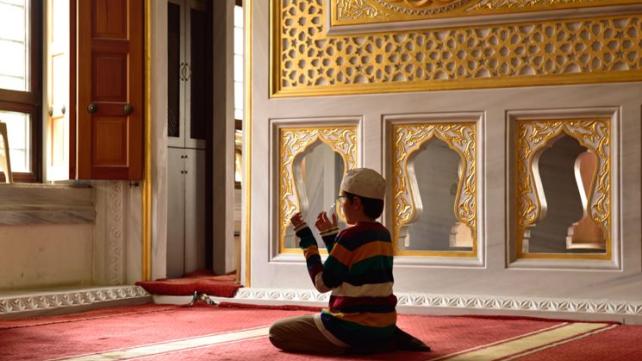
SUMMARY: Life beneath in the natural world beneath the open sky is an opportunity to remember its Majestic Creator.
There is something deeply stirring about standing beneath an open sky. Whether it is the soft blush of dawn, the brilliance of a midday sun, or the quiet scattering of stars at night, nature invites the heart into remembrance. For Muslim parents, these moments are not only personal spiritual opportunities—they are also powerful teaching tools for nurturing a child’s connection with Allah Most High. In a world filled with constant noise and distraction, stepping outside allows both parent and child to reconnect with something timeless - creation itself, which quietly and consistently points back to the Creator.
Allah Most High calls us throughout the Quran to reflect on the natural world, not merely as observers, but as believers seeking meaning. The skies, the earth, and the rhythm of day and night are not accidental; they are signs meant to awaken the heart and mind.
“Indeed, in the creation of the heavens and the earth, and the alternation of the night and the day, are signs for those of understanding.” (3:190)
“And it is He who spread out the earth and placed therein firmly set mountains and rivers… Indeed in that are signs for a people who give thought.” (13:3)
Again and again, Allah Most High directs our attention upward and outward - to the sky above us and the world around us. He calls us to look at the clouds as they are formed and driven, the rain as it falls and revives dead land, the stars as they adorn the heavens and guide travelers in darkness. He invites us to reflect on the mountains, firmly set to stabilize the earth, and the vast earth spread out as a place of rest and provision.
He draws our attention to the plants that grow, the crops we harvest, and the food we are sustained by - reminding us that provision comes from Him alone. He points to the animals we benefit from and domesticate, providing us with food, clothing, and transport. Even the smallest of creatures are signs: the bee, inspired to produce honey of healing, and the ant, small yet purposeful in its community and effort.
In all of these, there are signs - not only of power, but of care, wisdom, and mercy.
These verses remind us that reflection itself is an act of worship. When we invite our children to notice the way the clouds move or the way rain nourishes the earth, we are teaching them to see beyond the surface - to recognize purpose, design, and divine care.
The Prophet Muhammad, peace and blessings be upon him, modeled this connection beautifully. His relationship with nature was not passive; it was filled with awareness and remembrance. Everyday moments became opportunities for dua, grounding the heart in gratitude and reliance upon Allah subhanahu wa ta’ala.
“O Allah, make it a beneficial rain.” (Bukhari)
“O Allah, bring it over us with security and faith, safety and Islam…” (Tirmidhi)
These simple yet profound supplications teach us that even the most ordinary experiences - rainfall or the sighting of a new moon - can become acts of worship when tied to remembrance.
For children, nature is already full of wonder. They are naturally inclined to ask questions, to pause, and to marvel. This curiosity is a gift, and when guided gently, it becomes a pathway to iman. A child lying beneath the sky can be encouraged to whisper a simple dua, connecting what they see with what they feel: asking Allah Most High for a beautiful heart as they admire the beauty above them, or for growth in goodness as they watch a plant grow. These moments, though small, plant seeds of awareness that can last a lifetime.
Even routine family activities can be transformed into spiritual experiences. A walk through a park becomes an opportunity to reflect on Allah as Al-Khaliq, the Creator, or Ar-Razzaq, the Provider. The rustling of leaves, the flight of birds, and the changing colors of the sky all become reminders that Allah’s presence is near and His signs are everywhere.
"Our Lord, You did not create this in vain; exalted are You…” (3:191)
In these shared moments, dua becomes a living conversation—spontaneous, sincere, and deeply connected to the world around us.
The beauty of teaching dua through nature is that it removes the sense of distance. Children begin to understand that they do not need a specific time or place to speak to Allah. He is with them when they feel the wind, when they hear the rain, and when they gaze at the stars.
“And We are closer to him than his jugular vein.” (50:16)
This awareness nurtures a relationship with Allah, Most High that is constant, not confined. It teaches children that remembrance is not an obligation to fulfill, but a connection to cherish.
As parents, we are not only raising children - we are cultivating hearts. When we guide our children to see Allah Most High through His creation, we give them a lens through which the entire world becomes meaningful. The sky is no longer just sky, and the earth no longer just earth; everything becomes a sign, a reminder, and an invitation to turn back to Him.
Beneath the sky, surrounded by signs, every moment holds the potential for dua. And in every sincere dua, there is a step closer to the One who created it all.
O Allah, attach our hearts to You, show us Your signs in everything, and make us among those who remember You often.
Author bio: Miriam is the proud mother of seven children of different ages, an experience that shapes her perspective on education and advocacy. Based in the Chicagoland area, she has taught in an Islamic school and currently works in a public school, supporting students and families and promoting inclusive learning environments. As the mother of a child with autism, Miriam brings personal insight and compassion to her work advocating for children with diverse learning and developmental needs. She is passionate about fostering inclusion, understanding, and equity within her community.





Add new comment