
I was born into a house that never slept.
Our home breathed with voices, footsteps, laughter, and the quiet hum of prayer. Thirteen brothers and sisters filled its rooms, along with two aunties and my grandmother, who carried history in her voice and patience in her hands. The walls held generations. The floors remembered small feet learning to walk and older ones learning to stand firm. It was a house built not just of wood and brick, but of responsibility.
Before I was born, my grandfather had already left this world.
My grandmother used to say that his absence was not emptiness, but direction. He had passed away while traveling on a quest, working far from home, leaving behind stories instead of footprints. Inna lillahi wa inna ilayhi rajioun. To Allah we belong, and to Him we return.
My grandfather’s life had not begun as people expected. As a young man, he was a minor league baseball player, gifted, disciplined, and strong. Many believed he would reach the major leagues. But life does not always follow straight paths. At a time when the world was divided by race and confusion, he entered what was then called the Black Muslim Movement. The movement had its struggles and shortcomings, but guidance does not come from people. Hidayah is from Allah alone.
During those years, my grandfather met Malcolm X, known to many Muslims as Shaykh Malik Shabazz. Through that meeting, his heart turned fully toward the Qur’an and the Sunnah. He left slogans behind and took up submission. He joined the Qur’an and Sunnah Society and began to travel the world, not seeking fame or argument, but knowledge.
And something else awakened in him.
As he traveled, he learned not only about Islam, but about the earth itself. Forests, deserts, rivers, coastlines. He studied creation as a sign of the Creator and eventually worked as a conservationist. He believed protecting wildlife was a form of amanah, a trust from Allah. Animals were not objects to dominate, but communities, just as the Qur’an teaches.
By the time I was born, his journey had already ended in this world. I never met him. I never heard his voice or walked beside him. But I knew him.
I knew him through my grandmother’s stories late at night. Through my father’s careful words after salah. Through my aunties, who spoke of his courage, his discipline, and his humility. He lived in our home through memory, and memory shaped me.
One auntie in particular carried his fire.
Auntie Juwayriyah.
She had been young when her father passed away, but his mission stayed with her. Inspired by his life, she went to college and became a zoologist. She studied animals not as specimens, but as signs. She taught me that learning required patience, silence, and respect. That the best observer leaves no trace.
While she studied in classrooms and labs, I studied in the yard.
I practiced alone at first. Watching ants form roads through dirt. Learning the difference between frog calls in nearby ponds. Following the broken grass to see where rabbits passed. Reading the mud at riverbanks. Learning how birds scatter when danger approaches and how they settle when peace returns.
I never captured animals. I never caged them. I observed.
In parks, I learned to move slowly. In rivers, I learned how water hides and reveals. In ponds, I learned that stillness sees more than motion. My parents never discouraged me. They reminded me to be careful, to be respectful, and to remember Allaah in every place.
As I grew older, my responsibility grew with me.
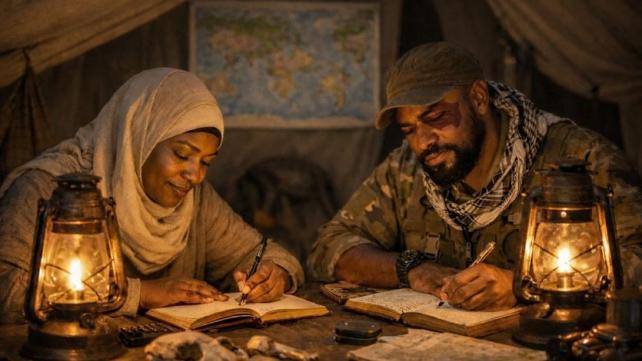
When I became old enough to be mahram, Auntie Juwayriyah invited me to travel with her. Not as a child tagging along, but as a partner in observation. Together, we conducted animal studies, recorded behaviors, and documented ecosystems that many people overlooked. Deserts others thought empty. Forests others feared. Rivers others rushed past.
We traveled light and moved carefully.
Soon, our work gained attention. Not because we were loud, but because we were precise. Grants followed. Support followed. A small production crew joined us, capturing our journeys on film so others could learn. The cameras never came first. The animals did.
Through it all, I remembered my grandfather.
I imagined him standing quietly at the edge of a forest, listening before stepping forward. I imagined him writing notes by lantern light. I imagined him smiling, knowing that his work had not ended, only changed hands.
Now people call me Mutaaqqib al-Haywanat.
The Tracker of Animals.
But my friends call me Muta.
I am not fearless. I am careful. I do not conquer. I observe. I do not chase glory. I follow signs. Each track in the sand, each feather, each ripple in water reminds me that creation speaks to those who slow down enough to listen.
My journey began long before my first step. It began in a house full of voices. In a grandfather I never met. In a faith that teaches us to walk lightly on the earth.
And with Allah’s permission, it will continue wherever the signs lead next.
Abu Hudhayfah Edwards is an author of Islamic children’s books dedicated to amplifying the voices and experiences of young Muslims living in the USA and Canada. As the creator of WKTL Radio, also known as IslamLife Radio, and Medina Educational Institute (MEI), he channels his passion for education and community into engaging stories that reflect the cultural styles and realities of Muslim youth. Once featured in Style Weekly in the article “After These Messages,” where he was described as “stoic and deep thinking,” Abu Hudhayfah Edwards continues to write with purpose and vision, committed to ensuring that Muslim children see themselves represented in the books they read.


Add new comment