
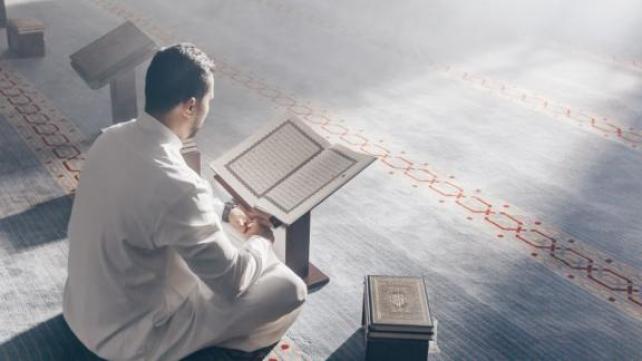
SUMMARY: How Muslims can fulfill the completion of a Quranic juz a day in Ramadan.
Completing the reading of the Holy Quran during the month of Ramadan is often a personal goal of many Muslims. Some may read or recite the Quran themselves, while others may attend taraweeh prayers at a local masjid where many communities will have a Hafiz leading the prayer and reciting at least one juz each night.
This recitation or reading of one juz each night is a practice that Muslims and Islamic institutions likely developed to make reading the Quran more convenient for the people. The Quran itself is divided into 114 chapters only and has no ajzāʼ designations. Some scholars explain that partitioning developed to aid in the study of Quran. This included dividing the Quran into seven parts (manazil) to help readers finish the book in one week or ruku’aat, the division of verses to facilitate recitation, especially during performance of taraweeh.
Still, every action has a foundation. The concept of reading the Quran during the month of Ramadan in stages is related to a hadith where it is implied that in each night of Ramadan, the prophet Muhammad, may Allah give him peace and blessings, reviewed and studied the revelation.
Abdullah ibn Abbas narrated, "The Prophet was the most generous person, and he used to become more so (generous) particularly in the month of Ramadan because Gabriel used to meet him every night of the month of Ramadan till it elapsed. Allah's Prophet used to recite the Qur'an for him. When Gabriel met him, he used to become more generous than the fast wind in doing good." (Sahih Al Bukhari 4997, Book 66, Hadith 19)
In addition, we have the reports that the Prophet Muhammad (may Allah give him peace and blessings) advised the companions of the merits of quality over quantity and balance of religious actions when people wanted to recite so much of the Quran in one sitting. If such practices had become the norm, it would have been a hardship upon the people who didn’t know that much of the Quran or couldn’t stand that long in prayer. The spirit of Islam is always balance in our pursuit to do what is most pleasing to Allah, The Most High.
"...Allah intends for you ease and does not intend for you hardship and [wants] for you to complete the period and to glorify Allah for that [to] which He has guided you; and perhaps you will be grateful". (Quran 2:185)
Many bound texts of the Qurah (mushaf) contain markings that divide it into juz or sections over 30 periods. Some recommend that reading a juz a day can be accomplished by reading about 4 or 5 pages after every salah. Others encourage reading the Quran early in the morning after fajr. Currently, there are several halaqas, communities, and institutions that offer daily reading of the Quran in person or virtually. This is in addition a Qari (reciter of Quran) offered by many masajid to lead the taraweeh salah each night.
For families, the juz division affords an opportunity. Reading and reciting the Holy Quran is a form of Ibadah. Most American Muslims have moved past rout recitation of Quran in Arabic with no personal understanding of the words because this practice has not added value to the Iman and application of deen in the Muslim community. A shared reading of a juz a day allows for reflection, discussion and understanding of what has been read.
A few ideas to make reading a juz a day a form of familial shared ibadah
- Families can designate times that everyone in the family is reading to themselves or as a group.
- Family members can take turns reading 4 or 5 pages after each salah
- It is likely that not all family members are in the home for each prayer, so an alternative action would be for family members to read individually when their schedule allows and then share a reflection on a message within the juz reading of the day that resonated with them later that night when the family is together breaking the fast
- Recitation of a portion of the juz may be included in the family communal salah which is most often the Salatul fajr, magrib and Isha for families with members in school or working. In addition, these prayer times are when the salah is performed aloud.
- Families can take turns reading a juz to the rest of the family
- One member can begin the juz at fajr time
- Another family member or two can continue an hour before fast breaking by having the family come together in the same room and reflecting upon Ramadan before the breaking of the fast
- Families can make reading of a juz part of the nightly constitution
- This also affords an opportunity to discuss the ayat or surat – meaning a small family halaqa
- Family members can take turns where one reads or recites the Arabic and the other reads the translation so there is meaning to the words spoken if the family’s native tongue is not Arabic
- Families can share the reading of a juz or a part of a juz with family members who live in other states or countries like grandparents or students in school with shared virtualization or even something as simple as reading together on a WhatsApp call.
- Families whose schedule is hectic may designate one day of the week where members share reflection on a ayah, or even one day of the week where the family comes together, sits in a circle and takes turn reading a portion of the juz for the day
- Family members can work towards good deeds practiced during Ramadan by
- Posting a list of the juz reading for the day
- Reminding family members to read
- Reading a juz to the younger members or grandparent
- Leaving off personal amusement and distraction and reading a juz themselves
- Family members can demonstrate the generosity practiced during Ramadan by
- Offering reflection on the juz applicable to family moments
- Study and relate points in the juz to other ayah in the Quran to help family members gain a more in depth understanding
Related:
Getting our Minds Ready for Ramadan: Mental Prep
Using Ramadan to Intensify Dua: Strengthening Faith through Supplication
7 Things you can do on Non-Fasting Days: A Ramadan Guide for Muslim Women







Add new comment