
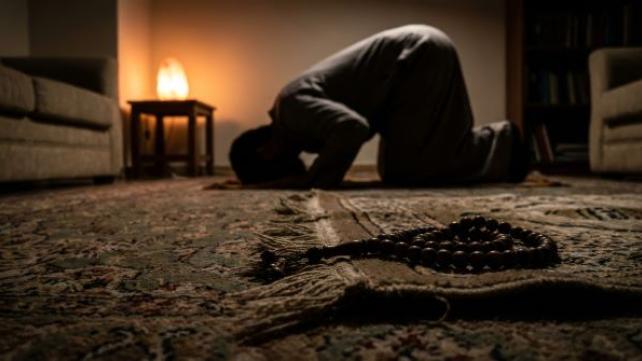
SUMMARY: The Tahajjud prayer in the late hours of the night is a particularly honorable form of worship and holds great blessings for Muslims, who can perform it both individually or as a family in order to sincerely call upon Allah.
Tahajjud prayer has been referred to as ‘the secret to attaining desires’ and ‘an arrow that never misses’. It holds an honored status in the ibadah of the Muslim because it is a prayer performed in the late hours of the night voluntarily by the worshipper. The deliberateness in intention of waking oneself up in the quiet stillness of the night to call on Allah with humility and focus is truly a state of sincerity and belief.
In Sahih Bukhari, we find the Prophet, may Allah send peace and blessings upon him, give a Hadith Qudsi about Allah: "Our Lord, may He be blessed and exalted, descends every night to the lowest heaven when the last third of the night remains and says: 'Who will call upon Me, that I may answer him? Who will ask of Me, that I may give him? Who will seek My forgiveness, that I may forgive him?' until the dawn breaks."
The spiritual elevation that comes from performing tahajjud is something to be shared in the family. Indeed, Allah instructs the believer to invite our family members to prayer in the Quran (20:132): "Bid your people to pray, and be diligent in it. We do not ask you to provide. It is We Who provide for you. And the ultimate outcome is for righteousness."
In his life example, Prophet Muhammad typically performed the tahajjud prayer alone, may Allah send peace and blessings upon him. However, many scholars have advised that tahajjud can be performed as a family and in particular can be shared by spouses.
Abu Huraira narrated that the Prophet, may Allah send peace and blessings upon him, said: "May Allah have mercy upon a man who wakes up at night and prays and awakens his wife. If she refuses, he sprinkles water on her face. May Allah have mercy upon a woman who wakes up at night and prays and awakens her husband. If he refuses, she sprinkles water on his face." (Sunan Abu Dawud)
Although praying together as a family affords family unity and blessings, the voluntary nature of tahajjud leans towards encouraging family members to perform this prayer on their own.
There is often an urge in parents to make things ‘fun’ for the children as a way of inviting them to participate. Still other parents impose acts of ibadah as a testament to faith. In Islam, the concept of wasatiyyah or the middle way is a guide for balancing our lives. We remind ourselves and our family members that sustainable, repeated actions one with sincerity are better than extreme actions.
Tahajjud is an act of worship – getting closer to Allah on a very personal level. In that quiet stillness of the night, the sincerity of uninterrupted supplication provides clarity and relief.
As parents seek and demonstrate the balance of religion, remind children that there is a balance to everything: there is a time of celebration – the Eid; there is a time of fasting – Ramadan; there is a time of clearing mind and body of debris and clutter – wudu; and there is a time for sincere private devotion – tahajjud prayer.
When children wake up on their own to make tahajjud, there is no exhibition of worship performed for the parents, but rather a sincerity on the part of the youth.
Parents can help their children with tahajjud with the some of the following suggestions
- Lead by example – allow children to observe parents making tahajjud prayer.
- Speak of the benefits of tahajjud when the family is gathered, perhaps at mealtime or at one of the fard salah.
- Encourage teens to make the salah and remind them tie it to part of the natural development of the human being as they approach and enter the age of responsibility. Also, point out that the summertime affords an opportunity to make tahajjud salah since many teens are up later at night anyway. Emphasize that they can balance their time away from just television, video games and idle activities and include the prayer
- Include younger children in a family tahajjud session. This allows the young ones to understand the intimacy and importance of the prayer. Allow the young one to make their own du’a so they feel they have participated. Be gentle in the activity with a minimum number of salah so as not to tax the children and perhaps a light refreshment afterwards. Later, get their feedback so the conversation is open to explain why Muslims go out of their way to perform this salah.
- Create intimate spaces within the home for family members to go to when they want to make tahajjud – this may include having an area with a prayer rug or dim lighting away from the regular house activity.
When the emphasis in the family remains of tahajjud being an individual act of ibadah, it is raised in significance and status. The children in the family are reinforced that this salah is a profound and sincere way to seek the pleasure of Allah.
The saying that tahajjud is an arrow that never misses reinforces the spiritual benefits of connecting with Allah with intention, sincerity, eager devotion and humility. There is no better way to spend a night.
Related:
(1) Prayer as the Most Consistent Act in the Muslim Home







Add new comment