
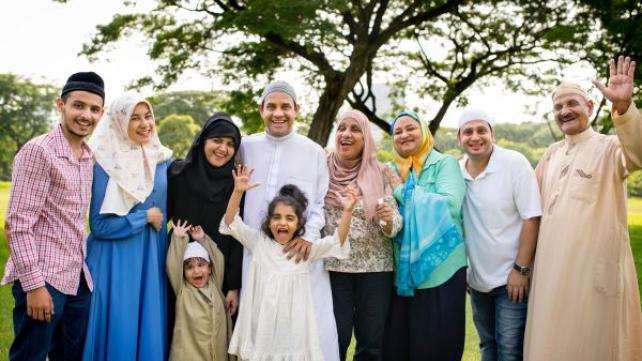
SUMMARY: Community support, even in small acts and favours, can help families raise righteous and well-balanced children.
For many Muslim parents, raising children can feel like a constant balancing act. Between work, school schedules, extracurricular activities, and the countless demands of modern life, it's easy to feel as though the responsibility rests entirely on our shoulders.
Islam offers a different vision. Children are not meant to be raised by isolated parents but within a caring community that shares in their growth, guidance, and well-being.
The proverb, "It takes a village to raise a child," reflects a truth woven into Muslim life. Yet there is another side to that wisdom: children do not simply benefit from the village—they help build it.
Through our children, neighbors become friends, elders become mentors, and families become connected. Parents meet while waiting for Qur'an classes, volunteering at the masjid, organizing youth activities, or celebrating Eid together. What begins as caring for children often grows into a network of friendship and support that strengthens the entire community.
Allah Almighty reminds us:
"Wealth and children are the adornment of the life of this world..."
(Qur'an 18:46)
Although children are entrusted first to their parents, they are also a blessing for the wider ummah. Every smiling face in the masjid, every curious question in weekend school, and every small voice saying "As-salamu 'alaykum" enriches the community.
The Prophet Muhammad peace and blessings be upon him modeled extraordinary love and gentleness toward children. He greeted them first, shortened the prayer when he heard a baby crying to ease the mother's concern, and allowed his grandsons to climb on his back during salah, extending his prostration until they finished playing. He taught that mercy toward children is a sign of true faith.
His example reminds us that children are not interruptions to community life—they are an essential part of it. When they are welcomed with patience and affection, they benefit from countless positive role models, while adults rediscover qualities children naturally draw out of us: compassion, gentleness, patience, and joy.
One of the simplest ways Muslim families strengthen their communities is through consistent presence.
Bringing children to the masjid—even when they are energetic—helps them see it as their spiritual home. Family programs, community iftars, Eid celebrations, classes, and service projects create opportunities for relationships to deepen over time.
Children often remember these ordinary moments far more than we realize: the auntie who saves them a cookie after halaqah, the uncle who asks about school, the older student who helps them memorize surahs, or the imam who knows them by name.
These seemingly small interactions become the foundation of belonging. They teach children that they are seen, valued, and loved beyond their immediate family.
Parents are a child's first teachers, but they were never meant to be the only ones.
Throughout Islamic history, great scholars and righteous believers were shaped not only by their parents but also by teachers, relatives, neighbors, and companions who nurtured their faith and character. The same remains true today.
A trusted weekend school teacher may awaken a lifelong love of the Qur'an. A grandparent quietly models sabr through everyday actions. A family friend inspires generosity through consistent service. A college student volunteering with the youth group becomes the role model a young child never knew they needed.
Each relationship adds another thread to the fabric of a child's faith.
Strong communities are rarely built through grand events alone. More often, they grow through simple acts of hospitality.
Inviting another family for dinner, sharing meals during Ramadan, visiting new parents, checking on elderly community members, or welcoming newcomers all create opportunities for meaningful connection. Children who witness this kind of hospitality learn that opening one's home, sharing one's time, and caring for others are acts of worship. These gatherings also allow friendships to flourish across cultures, ethnicities, and generations, reflecting the beautiful diversity of the ummah.
One of the greatest gifts we can offer our children is the opportunity to contribute.
Rather than simply keeping children occupied while adults volunteer, we can invite them to serve according to their abilities. A preschooler can hand out water bottles. An elementary-aged child can help organize food donations. A teenager can mentor younger children or assist with community programs.
These experiences teach children that they are not merely recipients of the community's care—they are valuable contributors to it. Service nurtures responsibility, confidence, gratitude, and empathy while helping young Muslims recognize that everyone has something meaningful to offer.
Modern society often separates people by age. Islam offers something richer.
When generations worship, learn, and serve together, everyone benefits. Children gain wisdom from elders, older adults find renewed purpose through relationships with youth, and families become more deeply connected. These intergenerational relationships create a community that no single household could build alone.
Healthy communities are not perfect communities.
Toddlers will make noise during the khutbah. Children will occasionally run where they should not. Teenagers will make mistakes. Parents will have exhausting days.
What matters most is how the community responds.
A smile instead of a glare. Gentle guidance instead of harsh criticism. Patience instead of judgment.
These moments often determine whether families feel welcomed enough to stay connected or quietly drift away. Every interaction teaches children what kind of Muslim community they belong to.
Children notice whether the masjid feels welcoming. They observe whether adults practice the compassion and forgiveness they preach. These experiences shape not only their childhood but also the adults they will become.
The Prophet peace and blessings be upon him said:
"Each of you is a shepherd, and each of you is responsible for his flock."
Parents carry the primary responsibility for raising their children, but every member of the community has a role in creating an environment where young Muslims can flourish.
Sometimes that means teaching. Sometimes it means listening. At other times it means helping an exhausted parent, encouraging a struggling teenager, welcoming a new family, or simply learning the names of the children who walk through the masjid doors each week.
These ordinary acts build trust, deepen relationships, and create the sense of belonging that allows communities to thrive.
In an increasingly individualistic world, Muslim families have an opportunity to revive a deeply Islamic tradition: raising children within a caring, connected community rooted in faith.
When parents intentionally involve their children in community life, they are doing far more than filling calendars with activities. They are weaving relationships that strengthen the ummah for generations to come.
That village is not built overnight. It grows through conversations after Jumm'ah, shared meals, volunteer projects, welcoming smiles, and countless everyday moments that remind children they are loved—not only by their own families, but by an entire community striving together for the sake of Allah.
Perhaps that is one of the greatest legacies we can leave behind: children who know they belong, communities that know they matter, and a generation prepared to extend that same sense of belonging to those who come after them. When we raise our children together, we are also strengthening the future of our ummah.
Author bio: Miriam is the proud mother of seven children of different ages, an experience that shapes her perspective on education and advocacy. Based in the Chicagoland area, she has taught in an Islamic school and currently works in a public school, supporting students and families and promoting inclusive learning environments. As the mother of a child with autism, Miriam brings personal insight and compassion to her work advocating for children with diverse learning and developmental needs. She is passionate about fostering inclusion, understanding, and equity within her community.
Related:
(1) Adopt a Convert this Ramadan: A Family Guide to Compassion
(2) Leaving a Legacy of Faith for your Family
(3) Baby Steps



Add new comment