
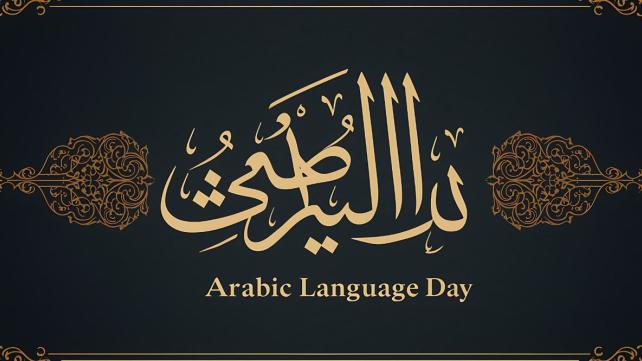
SUMMARY: The value and wonders of Arabic for Muslims on World Arabic Language Day
World Arabic Language Day was established by UNESCO (United Nations Educational, Scientific and Cultural Organization) to highlight and acknowledge the beauty and vastness of the Arabic language. It is observed on December 18th of each year because this day coincides with the 1973 UN proclamation of Arabic designated as the sixth official language of the UN.
As Muslims, we have a deep appreciate for Arabic because the holy Quran was revealed to mankind in this language. Muslims of every mother tongue stive to learn Arabic and use it daily to call the adhan and make the daily salah. Arabic is a language that is uniquely expressive and layered in meaning while also possessing simplicity of design. We need only to refer to the Quran itself to understand how articulate the Arabic language is when we read:
“…whereas this [Quran] is [in] eloquent Arabic”
Quran (16:103)
There is much weight to that ayah that Muslim place upon themselves to embrace and learn Arab. Since we understand the beauty of the Arabic language in general, we also acknowledge the importance of learning the Arabic language. Umar ibn Khattab said: "Learn the Arabic language because it is part of your religion, and learn the faraid (inheritance laws) because they are part of your religion." (Reported by Ibn Abi Shaybah 6/118)
Struggling to learn Arabic
- There is a beautiful reward and blessing from Allah when we struggle to read the Quran which was revealed in Arabic
- Learning Arabic moves us from passive receivers of Arabic to active participants leading to greater understanding
- Learning Arabic allows us to understand the guidance from Quran in its original language
- Learning Arabic helps us be part of those who preserve both the Quran and Islamic scholarship
- Speaking Arabic deepens our connection with Allah because we speak Arabic at every salah
- Arabic connects us with other Muslims around the globe regardless of their native tongue. Wherever one travels whether in China, Kenya, Germany, Australia, Brazil or the United States, the adhan wafts in Arabic for all to hear.
- Learning Arabic helps us understand core Islamic concepts in fiqh and reported sayings of the Prophet Muhammad, may Allah send peace and blessings upon him
Aisha narrated that the Prophet, may Allah send peace and blessings upon him, said, "Such a person as recites the Qur'an and masters it by heart, will be with the noble righteous scribes (in Heaven). And such a person exerts himself to learn the Qur'an by heart, and recites it with great difficulty, will have a double reward." (Sahih Bukhari, 4937)
Expressiveness of Arabic
- Arabic is called the "Language of Dawd" (Lughat al-Dawd) because of the distinctive Arabic letter ض (Ḍād). This letter has a heavy, emphatic 'd' sound that doesn't exist in most other languages.
- Every sound of the Arabic language has a significance, meaning or explanation.
- Arabic words are layered. A single written word in Arabic on average may have three meanings, seven pronunciations, and 12 interpretations.
- Arabic will have several words to denote specific concepts. For example, there are over a hundred words to describe the distinctiveness of a camel – age, color, gender, personality, sounds made, size, temperament etc. This allows for a specificity in speaking.
- Arabic has unique guttural and throat (pharyngeal) sounds that are not present in other languages.
- It is one of the oldest living languages. A living language is a language currently used by speakers as their primary means of communication. Dead language may be studied or only have words maintained. Researchers find that 20-25 languages are lost annually being overtaken by dominant lingua franca languages, national fragmentation, conflict and even climate change. Arabic has endured the centuries.
- It is the official language of 22 countries.
- Arabic has a trilateral root system or words made from a core three letters which helps memorization.
- Although there are over 30 Arabic dialects spoken around the world, Egyptian Arabic is the most widely colloquial version spoken
- Many other languages have been influenced by Arabic. The European Romance languages: Portuguese, Spanish, Catalan and Sicilian borrow words from Arabic. Also, African languages like Somali and Swahili have Arabic words. There is great influence of Arabic in Asia. Even in English there are borrowed Arabic words like algebra, coffee, lemon, magazine, safari and tariff.
Thoughtful acknowledge of the day
World Arabic Language Day is meant to acknowledge the beauty and distinctiveness of the Arabic language and its impact on the world. It is not a holiday, but certainly a wonderful opportunity for dawah
- Read the Quran – there is not better way to celebrate Arabic language than by reading the most important guide for mankind that was revealed and compiled in Arabic written language.
- Listen to the recitation of the Holy Quran in Arabic.
- Share ayah from the Holy Quran in Arabic that resonate with each other.
- Gather around the family from children to elders and remember ‘when’ you first learned Arabic or first understood the translation of the Arabic words used in salah
- Share the distinctive and unique characteristics of the language with non-Muslim family and friends.
- As a family, practice your Arabic with games, flash cards, phone apps.
- Color or paint Arabic calligraphy letters. These books can be found in many store chains that sale arts and crafts.
- Read a children’s book in written in Arabic
- Watch a movie in Arabic
- Check out a YouTube video on Arabic origins, or language practice
- Check your local Art Museum and see if they have an Arabic art or textile exhibit and go
- Practice only speaking to each other using Arabic words for the day
- Invite a native Arabic speaker over to share their perspectives on Arabic. In 2025, December 18th is on a Thursday, one of the voluntarily fasting days of the week. This is a wonderful opportunity to invite someone over to break fast and build community life.


Add new comment