
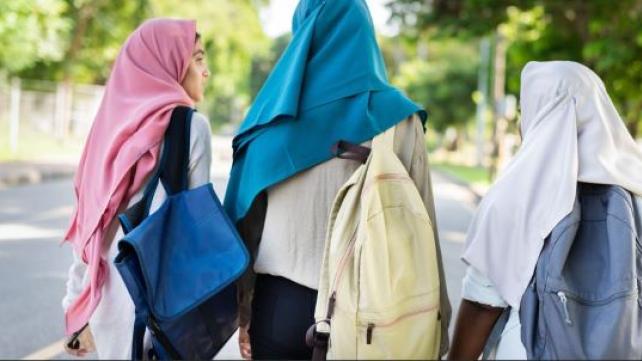
SUMMARY: Muslim women graduating into adolescence can take guidance from the practice of Prophet Muhammad, may Allah give him peace and blessings.
Adolescent Muslimah maturing into womanhood must value their position in Islamic society. One of the most distinguishing features of the Muslim is the haya – the modesty, the shyness. For an adolescent Muslimah this shyness must be navigated with care. Haya is an outward countenance, but it is also an internal spiritual state of Iman making the believer shy to move towards anything displeasing to Allah.
As young Muslimah develop into adults, we must reinforce the principles and examples by the Prophet Muhammad (may Allah give him peace and blessings) giving them equal access to Quran, Islamic thought, and participation in the society.
As with all things, we look to what Allah teaches us in the Holy Quran: "The believing men and believing women are allies of one another. They enjoin what is right and forbid what is wrong and establish prayer and give zakāh and obey Allah and His Messenger. It is they who will be shown Allah's mercy. Indeed, Allah is Exalted in Might and Wise." (9:71)
The prophet Muhammad (may Allah give him peace and blessings) gave women a major part in his life and the public life being careful to never neglect the believing women. It is reported in seerah that Bilal ibn Rabah, who was known for his booming voice, would accompany the prophet Muhammad (may Allah give him peace and blessings) and assist when needed. The prophet (may Allah give him peace and blessings) would move away from the men and specifically address the women, especially if they were situated far away because he knew Muslim women had mutual guardianship and responsibility in Islam.
He demonstrated consideration for the need of the women and girls in attendance to have equal access to receive the message from his own lips that men had heard. And in addition to equal access to Islamic knowledge, the Prophet Muhammad (may Allah give him peace and blessings) taught the men in the society to value girls and boys equally. Besides the hadith that we know extol the rewards of raising Muslim daughters in the way of Islam, we also find the Prophet (may Allah give him peace and blessings) made it clear that girls have rights to receiving respect, affection and acknowledgement as well.
Anas reported: A man was with the Messenger of Allah, may Allah give him peace and blessings, when his son came. He kissed him and sat him down on his thigh. Then, his daughter came and she sat to his side. The Prophet, may Allah give him peace and blessings, said, “Why do you not treat them equally?”
Source: Sharh Maani al-Athar 3838
Grade: Hasan (fair) according to Al-Albani
The Holy Quran teaches mankind that everything is created in pairs. Synonyms of the word pairs include to brace (support), complement and to equal. "And We created pairs of all things1 so perhaps you would be mindful." (51:49)
These ayah from the Holy Quran reinforce the position of women in Islam. The female is not like the male, but the two complement and support each other in the society.
Adolescent Muslim must be taught the practical wisdom of having women sit behind the men in salah as being related to hayaa and modest – and not inferiority. This behavior maintains a respectable decorum and is contextual.
The Prophet Muhammad (may Allah give him peace and blessings) was known for his kindness and mercy to all people – male, female, young, old, believer, disbeliever, companion and even enemy. As he prayed and perhaps because he was in a state of submission, seeking the Mercy of Allah, he extended kindness to a situation that many today would view as an interruption. Abdullah ibn Abbas reported:
The Messenger of Allah, may Allah give him peace and blessings, would be praying and two young girls would come and stand in front of him near his head. The Prophet, may Allah give him peace and blessings, would direct them to the side, or he would gesture with his hand right or left. (Musnad Ahmad 2894)
Grade: Sahih (authentic) according to Ahmad Shakir
Here, we don’t see the Prophet (may Allah give him peace and blessings) angrily pushing the girls away as they dare to stand next to him, but rather welcoming them to join him in his ibadah. They were just small children. But his kindness was not just limited to small children. The prophet Muhammad (may Allah give him peace and blessings) was acutely aware of how the physical changes of puberty were a subject of intense shyness and angst in adolescent Muslim.
During the Battle of Khaybar, a group of women from the tribe of Ghibar asked if they could attend the wounded upon the battlefield. A young girl, Umayyah bint Qays, was present and the Prophet (may Allah give him peace and blessings) invited her to sit and ride on his camel. While sitting her menarche commences and she was naturally shy about any traces of blood getting on the camel’s cover. Ever gentle and kind, Prophet Muhammad (may Allah give him peace and blessings) reassured the young sahabiyyah, helped her and gifted her with a necklace which he placed around his neck with his own hands. Naturally this special attention removed the awkwardness and created a beautiful memory as it was said that Umayyah bint Qays wore the necklace until her death.
Besides demonstrating social grace and decorum, young Muslimah learn that the natural function of their bodies is ordained by Allah, and although menarche is a private matter, it is also normal, manageable and should perhaps even be celebrated.
The expressive Quranic verses highlighting the believing female, the heartfelt hadith insisting upon equal love and attention and the gentle kindness that the Prophet (may Allah give him peace and blessings) extended to a young sahabiyyah is a reminder of the beauty of Islam and how that radiates upon all our young sisters.
Author bio: Mahasin D. Shamsid-Deen is the news curator and content manager for Muslim Network TV (MNTV) and contributing writer for Sound Vision. She holds a Master’s degree in English Writing and has worked as both a High School and College ESL Instructor and Writing Instructor for more than a decade. Mahasin has numerous published articles, books, essays and is a published playwright with three award winning stage plays. She is currently writing her dissertation for her doctoral degree


Add new comment