
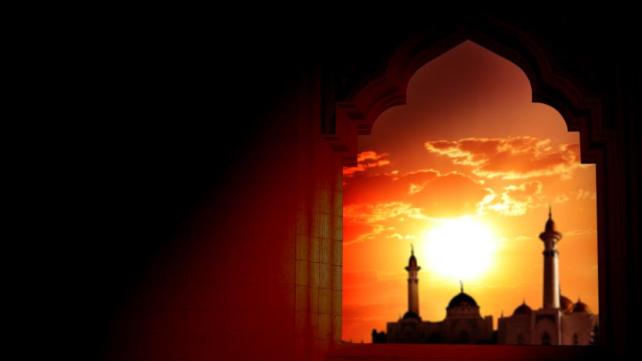
Safwan’s mom taped the poem to the fridge like it was a family announcement.
The paper was slightly crooked, stuck under a magnet shaped like the Kaabah, and Safwan had read it so many times that certain lines started to follow him around the house.
Ramadan… the gates of heaven open wide…
He was fifteen, big enough now that his shoulders brushed the doorframe at times, old enough to pretend he didn’t care about things, and young enough that his heart still got tight in his chest at the idea of being seen by Allah.
Outside, late Sha’baan had that confused weather. One day, it felt like spring was trying to show off. The next day, the cold crept back like it forgot something. Safwan stood by the living room window, palm on the glass, and watched the sky fade into that quiet blue that always made him feel like the world was holding its breath.
His father’s voice floated from the kitchen.
“Tonight, we look.”
Safwan tried to sound casual, “For the Hilal (crescent)?” His voice cracked halfway between the baritone of adulthood and the soprano pitch of his youth.
“For the Hilal,” his father confirmed, as if! saying it out loud made it more real. “Twenty-nine of Shaaban. We follow what the Prophet, may Allah send peace and blessings on him, taught us. If we see it, we start fasting tomorrow. If it’s cloudy, we complete thirty.”
His little sister, Huda, popped into the room and spun like she was in a commercial. “Ramadhan is coming. Ramadhan is coming.”
Safwan smiled without meaning to. Then he remembered school.
Ramadan at fifteen wasn’t like it had been at ten, when his biggest challenge was not licking frosting from cupcakes at lunchtime, or fasting in between meals. Now it meant basketball tryouts, group projects, hallway drama, exams, and friends who asked questions that were half curiosity, half challenge.
So you don’t even drink water?
How do you not pass out?
Why do you do that?
He had answers. He’d practiced them. But the truth was: sometimes the questions didn’t bother him as much as his own thoughts did. The part of him that could be brave in public and weak alone. The part of him that wanted to be “strong” the way people said strong Muslims were supposed to be, while also wanting to be comfortable like everybody else.
His phone buzzed.
A message from his friend Malik: Moon-sighting at the masjid tonight?
Safwan typed back: Yeah. You going?
Bet. See you there.
He shoved the phone into his pocket and went to help his mom pack the picnic-style stuff they always brought for moon sighting: a thermos of mint tea for after, a bag of dates “just in case,” and a folded prayer rug that smelled faintly of laundry detergent and the masjid carpet.
On the drive, Safwan watched the streetlights flicker on one by one. The city looked ordinary: cars, strip malls, people walking dogs, but he knew there was something special hidden inside the night, like a secret that only opened when you paid attention.
At the masjid, families gathered in clusters. Kids ran around the courtyard as if their energy had its own schedule. The older men stood near the entrance, scanning the horizon as if they could pull the crescent out of the sky with pure certainty. Someone had brought binoculars. Someone else had brought a telescope that looked like it belonged in a science museum.
Safwan found Malik near the shoe racks.
Malik leaned in. “Bro, you ready?”
Safwan shrugged. “Ready for what?”
“For Ramadan,” Malik said, wide-eyed like it was the playoffs. “The whole month. Taraweeh. Suhoor. Quran. All of it.”
Safwan wanted to match his excitement, but the truth slipped out. “I’m… nervous.”
Malik blinked. “About fasting?”
“About me,” Safwan said. Then he immediately regretted how dramatic it sounded.
But Malik didn’t laugh. He just nodded like he understood.
“You know what my uncle says?” Malik whispered. “If you’re nervous, it means you care. People who don’t care aren’t nervous. They’re asleep.”
Safwan looked across the courtyard and saw his father talking to the imam. His father’s face was calm, steady. Safwan wondered what it felt like to carry faith the way his dad did, like a lantern that didn’t shake in the wind.
They walked toward the grassy area behind the masjid, where the view was wider. The Imam came out each month to sight the Hilal, not just for Ramadan and Dhul-Hijjah. The sky was streaked with thin clouds, the kind that looked innocent but could hide anything.
The imam’s voice called out softly, guiding everyone. “Look carefully. The new moon is a thin witness. Sometimes you see it. Sometimes you trust the method and complete the month.”
Safwan tilted his head back, scanning the horizon. His eyes watered from staring too hard. He wanted to be the one who saw it first. Not for attention, just for certainty. For a feeling that Ramadan had arrived like a guest knocking at his door and not a fog rolling in.
A little boy nearby shouted, “I see it!”
Everyone leaned.
“Where?” someone asked.
The boy pointed wildly and then frowned, embarrassed. “I think… I think it was a plane.”
A few people chuckled, gentle and kind, like the whole community was wrapped in the same soft blanket.
Safwan kept looking. His mind started to replay the fridge poem like a song.
Ramadan… the gates of heaven open wide.
He imagined those doors in Heaven opening, not as something far away, but as opportunities right in front of him. A door to patience when he got annoyed. A door to lowering his gaze when a video popped up on his phone. A door to telling the truth when it would be easier to lie. A door to praying on time, even when homework felt heavier than his prayer rug.
Malik nudged him. “You think we’ll see it?”
Safwan squinted harder. “The clouds are annoying.”
“Even if we don’t,” Malik said, “we still get Ramadhan. Either tomorrow or the day after. It’s still coming.”
That’s when Safwan heard his father calling his name.
“Safwan.”
He walked over. His father handed him the binoculars. “Try.”
Safwan lifted them to his eyes. The world narrowed, focused. He felt his breathing slow down. The horizon sharpened.
Then, for a second… just a second… he saw something like a silver eyelash resting in the sky. So thin he almost missed it. So quiet it didn’t demand attention. Just… there.
Safwan’s throat tightened. “Baba.”
His father leaned in. “You see it?”
Safwan lowered the binoculars and looked again with his bare eyes, afraid the moment would vanish if he relied on tools. The crescent was still there, faint but undeniable, peeking through a break in the cloud like mercy making room for itself.
“I see it,” Safwan whispered.
His father’s hand rested on his shoulder. “Alhamdulillah.”
The imam made the announcement soon after, and the courtyard shifted. People smiled. Kids cheered like it was Eid. Phones came out. Messages flew to relatives. “Ramadan Mubarak!” “We start tomorrow!” “Make du’a for us!”
Safwan stood still for a moment, letting the happiness move around him like warm air.
On the way home, the car felt quieter, not because nobody spoke, but because the quiet had meaning now. Safwan stared out the window at the dark streets and tried to picture himself waking up before dawn.
Suhoor.
His mom would set out something light: maybe oatmeal, maybe eggs, maybe leftover rice. His dad would remind them gently to eat and drink. Safwan remembered another line from the poem, the one about the Sunnah, about that pre-dawn meal.
It wasn’t just about food. It was about showing up. About preparing while the world slept.
At home, his mom moved through the kitchen like Ramadan lived in her bones. She wrote a grocery list with extra dates, yogurt, soup ingredients, and fruit. Huda asked a million questions about taraweeh. Safwan helped set the table for a “practice suhoor,” which was really just an excuse for his mom to make sure everyone understood the plan.
Before bed, Safwan went to the fridge again and read the poem.
The lines about intending the night before made him pause.
To intend, the night before… a day of fasting for our Lord…
Safwan went to his room, turned off the light, and sat on his prayer rug in the dim glow of his phone screen. His heart felt crowded, school, sports, social media, doubts, hopes, everything.
He set the phone face down.
Then he spoke, quietly, the way you speak when you don’t need anyone else to hear you.
“O Allah… I intend to fast tomorrow for You.”
He waited, expecting some dramatic feeling. Instead, what came was a calm that didn’t shout. A simple steadiness. Like the crescent moon itself, thin, humble, but true.
He thought about people who were allowed not to fast: the traveler, the sick. He thought about how mercy was built into the rules, not as an exception, but as part of Allah’s wisdom. He thought about women who had to stop fasting when their menses came, and how Allah didn’t ask anyone to fight their own body to prove devotion. Safwan had heard those rulings since childhood, but tonight they felt like something deeper: Islam wasn’t a religion of performance. It was a religion of obedience shaped by compassion.
Safwan rolled on his right side and listened to the house settle into sleep.
Tomorrow would be his first fast of the month.
He knew it would be hard. He would get thirsty in math class. He would smell someone’s fries in the cafeteria and feel his stomach complain like a dramatic actor. He might get irritated at Malik for chewing too loudly, even though Malik wouldn’t be chewing at all. He might want to quit, or complain, or scroll his phone until his eyes hurt just to forget hunger.
But Safwan also knew this: Ramadan was not coming to crush him.
It was coming to wake him up.
And somewhere, beyond the clouds and city lights, the gates of heaven were open wide.
……………..
Author bio: Abu Hudhayfah Edwards is an author of Islamic children’s books dedicated to amplifying the voices and experiences of young Muslims living in the USA and Canada. As the creator of WKTL Radio, also known as IslamLife Radio, and Medina Educational Institute (MEI), he channels his passion for education and community into engaging stories that reflect the cultural styles and realities of Muslim youth. Once featured in Style Weekly in the article “After These Messages,” where he was described as “stoic and deep thinking,” Abu Hudhayfah Edwards continues to write with purpose and vision, committed to ensuring that Muslim children see themselves represented in the books they read.




Add new comment