
SUMMARY: Discover how the efforts of Jalal Abualrub have quietly helped millions of English-speaking Muslims access Islamic scholarship.
In an age where access to knowledge is often measured by speed and convenience, there remains a quieter, more deliberate effort happening behind the scenes. It is the work of translators, scholars who labor to carry the weight of centuries across languages, cultures, and generations. Among those who have contributed significantly to this effort is Jalal Abualrub, a name that may not always headline discussions, yet whose work sits on the shelves of homes, Masajid, and classrooms across the English-speaking world.
Who is Jalal Abualrub?
Jalal Abualrub is a contemporary researcher, writer, and translator known for his extensive work in rendering classical Islamic texts into English. His efforts are closely associated with major Islamic publishing houses such as Darussalam and Dar for Islamic Heritage. While detailed public biographical data about his early life remains limited Shaykh Abualrub is recognized as a student of the renowned Hadith scholar Muhammad Nasiruddin Albani. His intellectual footprint and path as a Student of Knowledge is unmistakable.
He belongs to a generation of scholars and translators who recognized a critical gap: the vast treasury of Islamic knowledge preserved in Arabic remained largely inaccessible to English-speaking Muslims. His work is part of a broader scholarly movement aimed at correcting that imbalance.
His Role in Translation - More Than Language
Translation, in this context, is not a mechanical process. It is a scholarly responsibility. It requires:
- Deep grounding in classical Arabic
- Understanding of Islamic jurisprudence and creed
- Sensitivity to context, nuance, and intended meaning
Abualrub’s work reflects this layered responsibility. His translations are not merely linguistic conversions but guided interpretations that aim to preserve the integrity of the original texts.
Key Contributions
His translation portfolio is extensive and deeply rooted in foundational Islamic scholarship:
Major Works
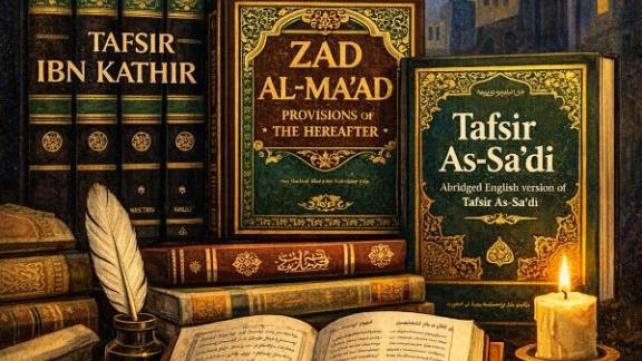
- Zad al-Maad by Imam Shamsuddin Muhammad Ibnul-Qayyim: a monumental work on the life, guidance, and practices of the Prophet ﷺ
- Tafsir As-Saadi by Abdul-Rahman Saadi (published by Darussalam) - a widely respected, accessible Quranic commentary
- Portions of Tafsir Ibn Kathir by Imaduddin Ismail Ibn Kathir: one of the most authoritative classical exegeses of the Qur’an
Darussalam Contributions
Abualrub translated numerous important works, including:
- Multiple volumes (Juzou) of Tafsir Ibn Kathir
- Pillars of Islam by Abdullah Ibn Jibrin
- Silent Moments by Abdul-Malik Qasim
- How to Achieve Happiness by Abdul-Rahman Saadi
- Healing with the Medicine of the Prophet ﷺ by Ibnul-Qayyim
- The Seerah by Safiur-Rahman Mubarakpuri
- Establish the Prayer and the Prize is Paradise by Abdul-Malik Qasim
Dar for Islamic Heritage Contributions
- Innovation and Its Evil Effects by Saleh Fawzan
- Rights Basic to the Natural Human Constitution by Muhammad Uthaymin
- The Hadith is Proof Itself by Muhammad Nasiruddin Albani
- Explaining the Pillars of Iman by Uthaymin
- Book of Sincerity by Husain Awaisha
- Forty Hadith Nawawi — Basics & Benefits by Nazim Sultan
- Numerous articles in The Muslim Creed magazine
His ongoing work on Tafsir al-Saadi reflects a long-term commitment to making comprehensive Qur’anic understanding available in English.
The Hidden Labor Behind Every Page
What often goes unseen is the intellectual and physical labor behind these works.
A single volume of tafsīr can take years to translate, edit, verify, and publish. Every sentence must be weighed. Every term must be carefully chosen. A mistranslation is not merely an error, it can distort meaning in matters of belief and practice.
This is not content production. It is preservation.
Why Supporting These Works Matters
There is a growing problem that threatens this entire ecosystem: Piracy.
PDFs of these works circulate freely online. Entire libraries are downloaded without a single purchase being made. While the intention may be convenience, the consequence is long-term harm.
When we choose not to purchase:
- Translators are not compensated for years of work
- Publishers cannot sustain large translation projects
- Future works remain untranslated
- The pipeline of knowledge slows or stops
Supporting these works financially is not just a transaction. It is participation in the preservation of Islamic knowledge.
A Community Responsibility
The English-speaking Muslim community stands at a unique point in history. Never before has access to classical Islamic scholarship been so widespread. But access alone is not sustainability.
If we want:
- More tafsīr in clear English
- More works of ʿaqīdah, fiqh, and seerah
- More books for our children and youth
Then we must support the very system that produces them.
Buying a book is not just ownership, it is investment.
The Real Cost of “Free”
When a book is pirated, the immediate benefit is personal. But the long-term cost is communal.
It means:
- Fewer translators like Jalal Abualrub can dedicate their lives to this work
- Fewer publishers are willing to take on large, complex projects
- The next generation grows up with gaps in accessible knowledge
And those gaps are not easily filled.
Moving Forward - A Culture of Support
The path forward is simple, but it requires intention:
- Purchase authentic copies when available
- Encourage Masajid and libraries to stock these works
- Gift books instead of forwarding PDFs
- Teach younger generations the value of preserving knowledge
This is how civilizations sustain themselves.
Jalal Abualrub represents more than a single individual. He represents a class of scholars working quietly to ensure that the words of the past remain alive in the present.
Their work has reached us.
The question is whether we will sustain it.
Related:
(1) The Little Masjid on the Prairie...and the Future of Rural Muslim America







Add new comment