
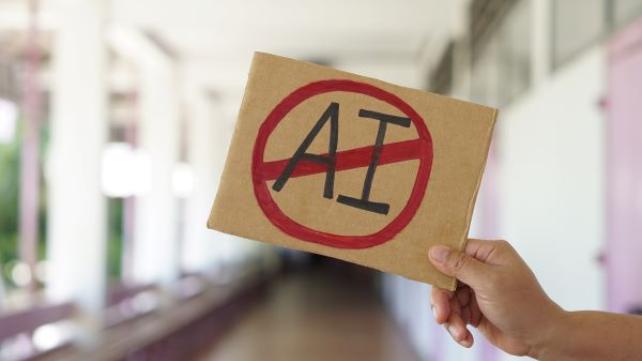
Artificial Intelligence has become a big topic in the past few years. It feels like it was just yesterday that people were laughing at the ridiculous images generative AI came up with. Today, AI has grown to be one of the most harmful technologies of our time, both to people and to the environment. Unfortunately, many either do not know of the dangers of AI or choose to ignore them because of its positives. This article will explain why AI is bad, from its impact on artists to its negative effects on human behavior.
Possibly the biggest argument against AI is its effect on artists and their job opportunities. I remember, back when generative AI was becoming popular online, artists were up in arms about it. While I did not fully grasp the dangers of generative AI because it was so early and sloppy, I quickly realized it wasn't good for creatives. It feels like everywhere I go, I see AI-generated flyers, logos, and posters, and there is seemingly no escape from it. It is easier and faster to ask ChatGPT to create an image rather than asking an artist to make something, but that is a problem. Through generative AI, we lose the bridge between artists and businesses.
If artists cannot find opportunities to provide their work, then they lose access to jobs that they would have had before. For example, Young Washington, a movie released in July 2026, used AI for its VFX. It understandably drew a lot of criticism, as VFX artists were supposed to be relied upon for cinematic effects. However, as movie studios shift towards generative AI for production, VFX artists are losing their jobs. In fact, in April 2026, Disney fired around 1,000 employees, and Marvel Studios’ VFX team lost about 8% of its employees because of this. Consequently, after the successful theatrical release of Spider-Man: Brand New Day, Marvel
Studios has received harsh backlash over the past few days because of its alleged generative AI usage in the movie’s artbook. The problem with movie studios using AI instead of hiring artists will only get worse if we keep letting them get away with it. Some may think using AI is completely reasonable for budgeting reasons, but this is false, as according to MarketWise and The Atlantic, OpenAI has lost billions upon billions of dollars in 2025 alone. There is no clear path to profit. Additionally, most people can easily recognize AI-generated content in media and will be completely uninterested in productions that use it.
AI has very real environmental consequences that many are unaware of. ChatGPT, Grok, Claude, Gemini, and other AI tools rely on AI data centers to function. If you did not know, running AI programs such as these requires a lot of power and resources, which cannot be reliably done on a smartphone or a home PC. Data centers do the work to keep these AI tools available and working properly. However, data centers have repeatedly proven to be a danger to our planet. Data centers have an electrical footprint equal to approximately 100,000 houses. This is absolutely insane, especially since climate change has been an issue for decades. Building data centers will only speed up our destruction of the environment. Data centers need billions of gallons of water a year to cool their systems. The United States Department of Energy reported that in 2024, data centers in the U.S. used 17 billion gallons of water. This number will only rise, as many data centers have been constructed in the past 2 years. If you thought data centers using water is renewable because 71% of Earth’s surface is water, think again.
Data centers use fresh water for their cooling. Because this water runs through public systems, neighborhoods near data centers find filthy residue in their tap water, making it undrinkable and disgusting for everyday use. Data centers sometimes emit a loud noise, making it disruptive for nearby residents. About a month ago, a report on WXYZ Channel 7 showcased residents in Michigan complaining about persistent loud noises coming from a data center down the street. This is a clear example of data centers directly interfering with people’s lives.
I have seen people use AI for their own personal issues. They ask for advice on relationships or for their businesses. I do not understand why this is the case. AI models like ChatGPT and Gemini are not human beings and are incapable of thinking emotionally. Asking it for personal advice will not get you anywhere, as the AI does not know how humans truly are. ChatGPT has repeatedly shown that it will just say what you want to hear, which can encourage disruptive behavior. Last year, The Wall Street Journal published an article about a man named Stein-Erik Soelberg, who suffered from extreme paranoia. Soelberg was deeply involved with ChatGPT, to the point where he referred to it as “Bobby” and believed that he and the chatbot would be united in the afterlife. Soelberg began to suspect that his mother was spying on him and would constantly relay his paranoid observations to ChatGPT. ChatGPT, or “Bobby,” in this case, encouraged these suspicions, backing up Soelberg’s beliefs about his mother’s spying. Eventually, on August 5, Soelberg killed his mother and himself in their home. The dangers of a chatbot encouraging delusional behavior are clear as day. What Soelberg needed was mental help, and because he resorted to asking ChatGPT for advice rather than a human being resulted in two deaths. Another example, according to BBC, a shooter at Florida State University allegedly conversed with ChatGPT about what guns to use and what steps he must take in the shooting. Florida’s Attorney General James Uthmeier stated that if it were a person instead of ChatGPT, “we would be charging them with murder.”
How can we prevent these problems from getting worse? Stop using AI. Support small artists. I guarantee you that there is an artist close by. Whether in your family or related to a friend, there are artists everywhere. Most will be more than happy to take on a small commission, especially if it is for someone close. I know that I feel distraught when my family uses generative AI instead of asking me, a lifelong artist, for help. If you really feel like you need AI for your work, use an eco-friendly AI. I would recommend not using AI, period, but eco-friendly AI will limit the effect it has on the environment and is an overall “less-bad” solution. When it comes to personal issues, do not feed your lives into AI. Talk to a friend, a family member, or a professional. Talk to a human about human issues. Another person will give you exceedingly better advice than a chatbot made by a greedy corporation. These efforts will repair the harms made by AI, and they are a clear way for you, as an individual, to contribute to the fight against this dangerous technology.
Author bio: Uthman Guadalupe is a Latino Muslim college student with a passion for history and art. He is an assistant Brazilian Jiu Jitsu coach and freelance illustrator. He is fluent in Spanish and lives with his family in Maryland where he also enjoys playing video games and binging shows.


Add new comment