
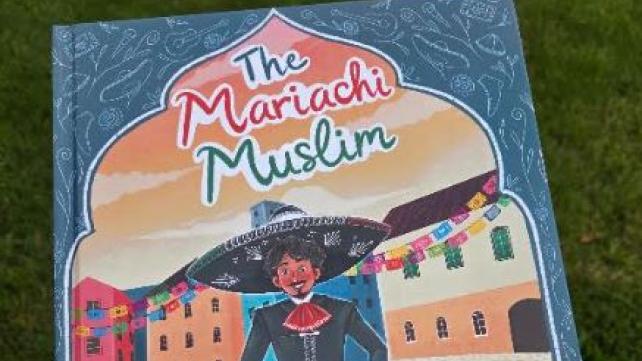
“Necessity is the mother of invention,” as the proverb goes. In my case, I was quite literally a mother in search of a solution. When my first child was born in 2006, finding Islamic children’s books in Spanish was nearly impossible. My search continued into his toddler years and through the birth of my second child, until I finally took it upon myself to write books that could teach them about their faith in a language they could understand. With my family’s help, I wrote, illustrated, and self-published my first books, either entirely in Spanish or as bilingual editions. Interest from other bilingual families led us to produce and distribute more copies. What began as a few simple ideas grew into more than a dozen Islamic children’s books covering a variety of topics. In early 2026, twenty years after that initial search, the journey reached a new milestone with the release of my first traditionally published standalone book, The Mariachi Muslim.
It feels a little odd to write about one of my own books, but rather than review The Mariachi Muslim, I want to discuss what motivated it. In doing so, I hope to give readers an inside look at what goes on in an author’s mind when putting together a piece of literature. Every author is different, and while every book tells a story, it also has an origin story of its own. The creative process behind it can take many forms. For me, writing begins with inspiration. Something happens, someone says something, or a series of events occur that awakens in me the desire to put pen to paper and scribble down my thoughts. That was the case with The Mariachi Muslim.
For years, The Mariachi Muslim lived rent-free in my head, in the notepad on my phone, and on my laptop before it was finally published. The idea grew out of my own experiences and conversations with other Latino Muslims trying to find their place within the Muslim community. One of those interactions took place through my dawah work answering calls for the 1-877-WHY-ISLAM hotline. Although my cell phone was connected to the Spanish-language line 24 hours a day, I rarely received Spanish calls. Then, one evening, a call came in that affected me deeply. The caller was a Latino man who had embraced Islam but was beginning to question his decision after several difficult encounters with “born Muslims” at his local mosque.
His name was José, just like my older and only brother. He was of Mexican descent and lived near Chicago, where, despite the presence of an established Latino Muslim community, he had yet to meet another Latino Muslim. Like me, he learned about Islam through a Muslim friend who answered his questions and gave him reading material. Although José found some support at his local mosque, he still felt alone and out of place. He longed for a Spanish-speaking mentor who understood his cultural background and values. During our call, José shared that Muslims at the mosque often cornered him to reprimand him for tattoos he had gotten years earlier, insisted that he change his name to a “more Muslim” one, and left him confused about how to worship properly. Puzzled and noticeably upset, he asked me sincerely whether becoming Muslim meant giving up his Latino identity.
I reassured him that he did not need to change his name or erase his personality and culture to practice Islam. I knew well that while some brothers and sisters mean well when offering advice, they can come across as ignorant and rude. When that advice is shaped by stereotypes and preconceived notions about Latinos, it becomes a recipe for disaster. Instead of welcoming a new Muslim into the congregation, they may end up isolating that person or, worse, pushing them away completely. Fortunately, José simply needed reassurance from someone who had been in his shoes. By the end of our conversation, he felt relieved knowing that embracing Islam did not require him to sever his roots. I gave him contact information for other Latino Muslims in his area, but long after the call ended, his story stayed with me.
Then, in 2021, at the height of the COVID-19 pandemic, I came across another Latino Muslim named Mikaeel on Instagram. He drew and posted comics about his experiences and challenges as a Mexican Muslim convert, including several in which he depicted himself wearing a mariachi outfit. Many of his comic strips resonated with me, so I followed his page to support his work. As a gesture of appreciation, he created fan art for my book Eid Empanadas: A Latino Muslim Ramadan and Eid-ul-Fitr. That was when I got the idea to write a story about a Muslim mariachi, inspired by Latino converts like José and Mikaeel, as well as my family and others living at the intersection of faith and culture.
I wrote the first draft of The Mariachi Muslim in the notepad app on my phone, scrapped it, rewrote it, and returned to it later. It started as a poem, but after I read it to my family and got positive feedback, I became convinced I should develop it into a book. In 2024, I finally completed the manuscript. I asked Mikaeel to illustrate the story, but he declined, saying that he considered himself an amateur artist and was too busy to take on such a large project. At that point, I set aside my hopes of self-publishing it. Later, when I learned about Ruqaya’s Bookshelf, a small Islamic publishing house that provides a platform for Muslim storytellers, I submitted the manuscript.
Ruqaya’s Bookshelf founder and director, Asmaa Hussein, immediately embraced the project, offered feedback, and paired me with skilled editors and an illustrator. After months of rigorous back-and-forth editing and conceptualization, The Mariachi Muslim finally stepped out of my imagination and into the world as a published book. The illustrator, Dwika Angrainni, provided the beautiful artwork that brought my characters to life in ways that exceeded my expectations.
The vibrant picture book tells the story of a traveling mariachi singer who finds himself stranded outside a mosque when his band’s van breaks down. Captivated by the sound of Quranic recitation, he picks up a copy of the Quran, begins reading, and eventually pays the Muslim community a visit. What follows is an unexpected turn of events that leaves readers with a lesson about valuing diversity and embracing each other’s talents.
If you have been following my writing, you know that uplifting authentic Latino Muslim stories is at the core of what I do. I dedicated the book to every Latino Muslim who deserves to see themselves reflected on the page, including my own family. Our stories are part of Hispanic heritage, but also Islamic heritage, and Latino Muslim children deserve to know that their faith and culture can coexist. My eldest son is twenty now, but the need for Latino representation and Spanish-language resources within the Muslim community remains. We can support this work by purchasing books by Latino Muslim authors, sharing them with our families and communities, and helping these stories reach the readers who need them most.
So, what do Muslims and mariachis have in common? Find out in The Mariachi Muslim, available at ruqayasbookshelf.com. For other titles, visit amazon.com/author/wendydiaz.
Bio:
Wendy Díaz is a Puerto Rican Muslim writer, award-winning poet, former educator, and mother of six. She is the co-founder of Hablamos Islam, a non-profit organization that produces educational resources about Islam in Spanish (hablamosislam.org). She has written, illustrated, and published over a dozen children’s books and currently lives with her family in Maryland. Follow Wendy Díaz on social media @authorwendydiaz and @hablamosislam.


Add new comment